 Iran Chronicle
The Fall of Astyages: Cyrus and the Transformation of Median Power
Around 550 BCE, the army of the Median king Astyages turned against him and delivered him to Cyrus, king of Anshan. Cyrus’s subsequent occupation of Ecbatana marked a decisive expansion of his authority, but the nature of the political order he acquired remains debated. Part 3 examines the Babylonian evidence and later Greek traditions to assess the circumstances of Astyages’s defeat, the limits of the “Median Empire” model, and the continuing role of Median elites under Persian rule.
ACHAEMENID PERSIA · PART 3
Around 550 BCE, Astyages lost his kingdom after his army turned against him and delivered him to Cyrus, king of Anshan. Cyrus’s subsequent occupation of Ecbatana marked a decisive expansion of his authority. The significance of that victory, however, depends partly on a question that remains disputed: what kind of political order had Astyages ruled? By examining Babylonian records, later Greek narratives, and competing modern interpretations, this article considers both the circumstances of his defeat and the limits of describing Cyrus as the straightforward heir to a Median empire. The Nabonidus Chronicle records the overthrow in four damaged lines. Astyages assembled his army and marched against Cyrus. His troops rebelled, took him prisoner, and handed him over to their opponent. Cyrus then entered Ecbatana, described as a royal city, and carried its silver, gold, and other possessions to Anshan. The passage is conventionally assigned to Nabonidus’s sixth regnal year, 550–549 BCE, although the opening year designation is restored.¹
This account provides the strongest foundation for reconstructing the immediate event. It does not explain why the army rebelled, identify its commanders, or describe the battle through which Astyages lost control. Nor does it define the territories that subsequently acknowledged Cyrus. Those questions have often been answered by combining its brief statements with the much fuller narratives of Greek authors. Such a synthesis requires caution: accounts produced in different circumstances may preserve related events without sharing the same explanation of them.
Astyages and Cyrus: Evidence and Historical Interpretation
The power exercised by Astyages had developed within a region whose earlier political fragmentation is well documented. Karen Radner’s examination of Assyrian records identifies numerous Median principalities governed by hereditary “city lords.” These rulers entered agreements with Assyria, supplied horses, and negotiated their position among larger neighbouring powers. Even where Assyria established provinces, it frequently retained local dynasts alongside its own administration. Median political development therefore occurred within an environment already shaped by imperial intervention, regional competition, and the management of local elites.²
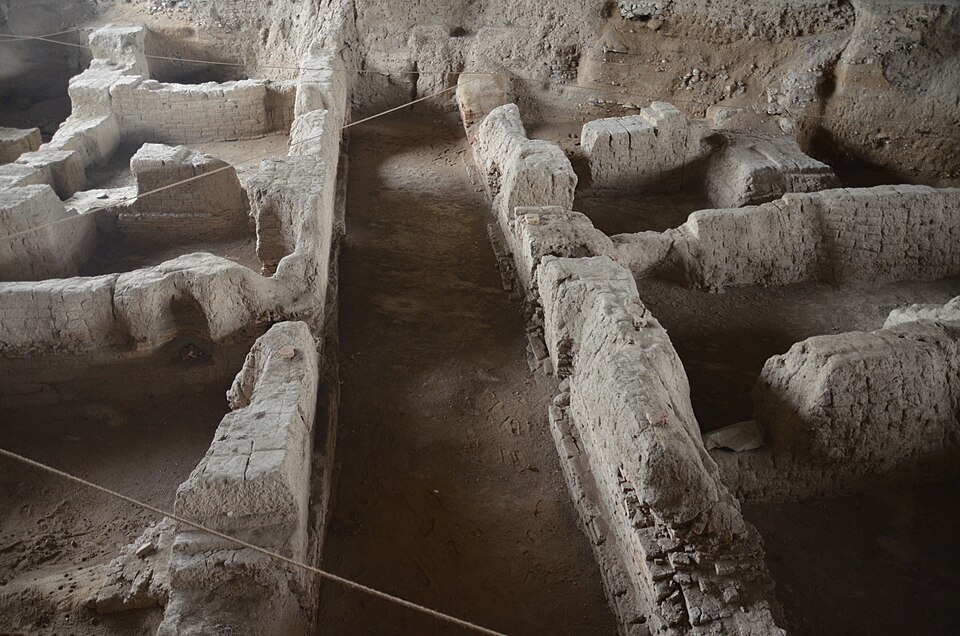
Archaeology provides a related, though not identical, perspective. Radner associates the fortified centres at Godin Tepe, Nush-i Jan, and Baba Jan with the regional principalities visible in the Assyrian evidence. Their substantial buildings demonstrate organised authority and the concentration of resources. They do not, by themselves, establish a single state governing the whole region. Similar architectural or ceramic traditions can indicate connections among centres without proving their incorporation into one administration. The chronological distinction is essential. Evidence for numerous principalities in the eighth and seventh centuries BCE does not establish that the same arrangements survived unchanged under Astyages. Radner explicitly acknowledges the gap separating the later Assyrian records from the appearance of Cyaxares at the head of a coordinated Median army. The institutional history of the period between the destruction of Assyria and Cyrus’s victory remains particularly obscure.
Babylonian evidence nevertheless establishes a significant concentration of military power. The Fall of Nineveh Chronicle records the Median capture of Ashur in 614 BCE, the agreement between Cyaxares and Nabopolassar, and their cooperation against Nineveh in 612. These events cannot be reduced to the actions of isolated village communities. They demonstrate sustained leadership and the capacity to conduct major campaigns. What remains uncertain is whether that military coordination produced extensive territorial government, and how long any such arrangements endured.² This distinction lies at the centre of the debate initiated by Heleen Sancisi-Weerdenburg’s question, “Was there ever a Median Empire?” Her challenge concerned the reconstruction of a bureaucratic imperial system comparable to Assyria or Achaemenid Persia. It did not require denying Median rulers or their military achievements. As Rémy Boucharlat explains in his assessment of the collective volume Continuity of Empire (?), subsequent scholarship proposed several alternatives: a shorter period of consolidation after the fall of Nineveh, a federation or confederation, a more restricted territory, or continued political plurality.³
 |  |
|---|
The alternatives should not be treated as interchangeable. A confederation, a territorial monarchy, and a network of dependent rulers imply different relationships between central authority and local power. The surviving evidence does not permit historians to select one model merely because it appears less elaborate than an empire. Each requires positive support. Christopher Tuplin offers an important counterweight to strongly sceptical reconstructions. His study of Median power in Media, Mesopotamia, and Anatolia explicitly defends the legitimacy of believing in Median domination beyond lowland Mesopotamia. The argument preserves a distinction between demonstrating influence or supremacy and reconstructing an extensive, uniformly administered state. It also challenges the assumption that the weaknesses of the conventional imperial model necessarily eliminate the possibility of substantial external domination.⁴
These positions differ in both their evidential emphasis and the political structures they consider plausible. Radner’s reconstruction begins with Assyrian documentation and the archaeology of regional centres; Tuplin gives a more affirmative assessment of the combined evidence for broader Median power. The appropriate conclusion is not that the debate has abolished the Median kingdom. Rather, the existence of powerful kings is more securely established than the administrative coherence and exact boundaries conventionally assigned to their dominion. Cyrus’s relationship with Astyages must be considered within this uncertainty. Herodotus presents the Persians as subjects of the Medes and Cyrus as the leader of their liberation. The Nabonidus Chronicle is less specific. It calls Cyrus king of Anshan and records Astyages’s expedition against him without defining their preceding relationship. The Nabonidus Cylinder from Sippar uses a phrase translated as “his second in rank,” but its precise significance is uncertain. It cannot independently establish the obligations of an Anshanite vassal.⁵
An existing Median supremacy remains possible. Regional kingship and dependence on a stronger ruler were not mutually exclusive. Nevertheless, no surviving agreement specifies tribute, military service, or administrative intervention in Anshan. Calling the conflict a revolt may follow Herodotus’s interpretation, but it should not imply that a detailed constitutional relationship has been recovered. The Sippar Cylinder also presents Cyrus’s victory within a markedly different explanatory framework. Nabonidus receives a divine instruction to restore the sanctuary of Sin at Harran but objects that the Mede’s power prevents him. Marduk promises to remove that obstacle. Cyrus then defeats Astyages with a small army and takes him captive. The passage makes the defeat of the Medes a fulfilment of divine intention supporting Nabonidus’s restoration.
Its reference to Nabonidus’s third year, approximately 553–552 BCE, differs from the Chronicle’s conventional sixth-year dating. Historians have reconciled them by proposing a conflict extending over roughly three years. That remains possible, but neither source supplies the intervening operations. The Cylinder compresses mobilisation, victory, and capture into its account of divine fulfilment; it does not explicitly describe the first stage of a prolonged war. The Chronicle’s report of military revolt is more specific about the mechanism of Astyages’s collapse. His own force ceased to recognise his command and delivered him to Cyrus. This establishes a breakdown of allegiance, but not its cause. Negotiation, elite opposition, military failure, or a combination of circumstances could explain the event.
Herodotus supplies an elaborate explanation through Harpagus. After failing to carry out Astyages’s order to kill the infant Cyrus, Harpagus suffers a punishment in which his own son is killed and served to him at a banquet. He later cultivates opposition among Median nobles and encourages Cyrus to rebel. Astyages nevertheless appoints him to command the army, enabling the conspiracy to determine its allegiance.⁶
 |  |
|---|
The narrative connects the king’s defeat with the consequences of his earlier cruelty. It also belongs to a larger account of Cyrus as Astyages’s grandson, preserved after an attempt to prevent the fulfilment of prophetic dreams. These features do not prove that every person or relationship is invented. They do mean that historical detail cannot be extracted without considering the story’s literary organisation. The Chronicle independently supports military disloyalty, not the banquet, the revenge motive, or Harpagus’s leadership of the conspiracy. Likewise, neither Babylonian account confirms Cyrus’s descent from Astyages. The safest reconstruction preserves those distinctions: the capture is well attested, the army’s revolt is explicitly recorded, and the personal explanation belongs to a later tradition.
Conquest, Continuity, and the Reorganisation of Power
The consequences of the victory depend partly on which reconstruction of Median authority is adopted. If Astyages controlled an extensive network of dependent rulers, his overthrow offered Cyrus an opportunity to claim supremacy over it. If the kingdom was territorially narrower or less cohesive, expansion beyond its centre would have required more substantial new acts of conquest and negotiation. In neither case does the capture of one monarch demonstrate the immediate submission of every territory associated with him.
The Chronicle establishes a more limited but consequential transfer. Cyrus occupied Ecbatana and appropriated royal wealth. Silver, gold, and other property passed to Anshan. These resources could support the victor’s position, although the text does not describe their subsequent use. It records neither the destruction of Ecbatana nor a comprehensive settlement for its inhabitants. The movement of treasure is therefore stronger evidence for the appropriation of concentrated royal resources than for the inheritance of an intact imperial administration. The political structures of later Achaemenid rule cannot simply be assigned to Astyages and then transferred wholesale to Cyrus. Such continuity must be demonstrated through particular institutions, personnel, or practices rather than assumed from the succession of rulers.
Radner’s account of earlier Assyrian government offers a useful comparative perspective. Assyrian authorities often preserved and strengthened local rulers when their cooperation served imperial interests. This is not evidence that Cyrus adopted the same arrangements, but it establishes that accommodation with regional elites was already part of the political history of western Iran. The choice between complete institutional replacement and unchanged continuity is consequently too restrictive. The military revolt itself suggests that allegiance could be detached from Astyages without requiring the destruction of the communities and resources on which his authority rested. Some accommodation between Cyrus and elements of the opposing force is plausible. Its terms, however, are not preserved. The sources do not establish a formal Persian–Median partnership, equality between their elites, or a uniform programme of exclusion.
Later evidence is clearer about the coexistence of Median service and Median resistance. Darius’s Behistun inscription records a claimant named Fravartish who declared himself Khshathrita, descended from the family of Cyaxares. According to Darius, Medes associated with the royal establishment joined him, and he became king in Media. The appeal to Cyaxares indicates the continuing political value of the earlier monarchy’s ancestry.⁷
The same inscription describes Persian and Median troops serving Darius and identifies the Mede Takhmaspada as a commander against another claimant invoking Cyaxares. Median identity thus did not determine a single political allegiance. Individuals and groups could seek advancement within the imperial order or support an alternative kingship. Behistun is not an impartial register of those choices. Darius presents his opponents as liars and his own victories as manifestations of divine favour. Their genealogical claims survive through a text designed to delegitimise them. The evidence establishes that such claims were made and considered politically significant; it does not independently verify the ancestry asserted.
Its chronology also limits the conclusions that can be drawn about Cyrus. The revolts of 522–521 BCE occurred almost three decades after Astyages’s defeat and under different dynastic circumstances. They demonstrate neither the precise settlement reached around 550 nor the uninterrupted survival of Astyages’s institutions. They show that Median personnel remained important and that memories of an earlier royal house could still mobilise opposition. This later evidence helps qualify two opposing interpretations of the conquest. The Medes did not disappear from political life after Astyages. Equally, their presence in imperial service does not establish that conquest produced a consensual union. Participation and subordination could coexist, just as incorporation could preserve rather than eliminate the resources for resistance.
The victory also altered the calculations of neighbouring monarchies. Herodotus connects Croesus’s decision to confront Cyrus with the growth of Persian power and the overthrow of Astyages, whom he identifies as Croesus’s brother-in-law. His account includes territorial ambition and the desire for revenge among the Lydian king’s motives. These explanations should be attributed to Herodotus rather than treated as independently preserved diplomatic evidence.⁸
The Sippar Cylinder supplies a contrasting Babylonian perspective. There Cyrus’s defeat of Astyages serves Nabonidus’s restoration narrative. The removal of Median power appears beneficial within the Babylonian king’s presentation of his own reign. Cyrus’s later conquest of Babylon should not be allowed to make this earlier relationship appear retrospectively hostile in every respect. The broader result was a substantial change in Cyrus’s position. He had overcome a ruler capable of assembling a major army, taken possession of a royal centre, and acquired its wealth. Those outcomes enlarged the resources and opportunities available to him. The extent to which he also inherited Astyages’s external dependencies remains inseparable from the unresolved geography of Median power.
A measured interpretation therefore requires two conclusions to be held together. The overthrow was a major transformation in the political order, not merely a minor dynastic incident. Yet its significance does not depend on assuming the existence of a territorially complete Median empire with institutions ready for Cyrus to inherit. His subsequent authority emerged through the appropriation of existing resources and relationships alongside further conquest and consolidation. The defeat of Astyages ended one king’s command, not the historical agency of the Medes. Cyrus’s achievement lay in converting that collapse into an expanding monarchy. The next article examines the extension of his power into Lydia, where the confrontation with Croesus brought the Persian kingdom towards the Aegean.
Bibliography
Nabonidus Chronicle(ABC 7), column II, lines 1–4. Translation by A. K. Grayson, with adjustments reproduced by Livius. The underlying evidence is the Babylonian chronicle; Livius is the online access point. The opening year designation is restored, and the passage is conventionally dated to 550–549 BCE.[livius]
Karen Radner, “Assyria and the Medes,” in D. T. Potts, ed.,The Oxford Handbook of Ancient Iran(2013), pp. 442–456, especially pp. 444–454. The accessible author proof contains her analysis of city lords, Assyrian accommodation with local dynasts, archaeological centres, and the documentary gaps surrounding Median consolidation. It also discusses the Babylonian evidence for Cyaxares’s campaigns. Her reconstruction of earlier principalities should not be projected unchanged into Astyages’s reign.[discovery.ucl.ac]
Rémy Boucharlat, review of G. B. Lanfranchi, M. Roaf, and R. Rollinger, eds.,Continuity of Empire (?). Assyria, Media, Persia,Topoi15/2 (2007), pp. 531–539. Boucharlat explains the scope of Sancisi-Weerdenburg’s challenge and the range of subsequent models. The account of her position here is mediated through this review and Radner’s discussion, rather than presented as a new reading of her complete original papers.[discovery.ucl.ac][persee]
Christopher Tuplin, “Medes in Media, Mesopotamia, and Anatolia: Empire, Hegemony, Domination or Illusion?”Ancient West & East3 (2004), pp. 223–251. The publisher’s abstract explicitly states the article’s defence of Median domination outside lowland Mesopotamia. That broad thesis, rather than an unverified reconstruction of the article’s detailed argument, is used here. The automatically generated summary on the repository page gives a misleading impression of its conclusion and has not been relied upon.[brill]
Nabonidus Cylinder from Sippar, column I, translation by Paul-Alain Beaulieu reproduced by Livius. The translation’s accompanying note identifies the uncertainty surrounding “his second in rank.” The foundation inscription’s theological purpose and third-year reference must be distinguished from the Chronicle’s formulation and conventional dating.[livius][livius]
Herodotus,Histories1.107–130, especially 1.117–119 and 1.123–128; translation by A. D. Godley,Loeb Classical Library, reproduced by Lacus Curtius. Herodotus supplies the kinship, punishment, and conspiracy narrative. The Chronicle corroborates an army revolt, not those explanatory details.[livius][penelope.uchicago]
Behistun inscription, §§24–25 and 31–35. The online translation is adapted from L. W. King and R. C. Thompson,The Sculptures and Inscription of Darius the Great on the Rock of Behistûn in Persia(1907). These passages support the specific observations concerning rival claims and Median service under Darius; they are not treated as a record of Cyrus’s original settlement.[livius]
Herodotus,Histories1.46 and 1.71–75, for Croesus’s response and the relationship with Astyages. Compare the different political presentation in theNabonidus Cylinder from Sippar. Neither text provides direct access to a ruler’s private deliberations.[livius][penelope.uchicago]
Continue this collection
Achaemenid Empire — Article 3 of 6