 Iran Chronicle
Cyrus and Croesus: The Conquest of Lydia
Walter Hutchinson 1877
Cyrus’s conquest of Lydia carried Persian power into western Anatolia and brought it to the shores of the Aegean. This article examines the conflict with Croesus, the violent capture of Sardis, and the uneven process of incorporating the defeated kingdom into an expanding empire. Reading Herodotus alongside Babylonian evidence, archaeology, and modern scholarship, it separates the familiar stories of prophecy and royal downfall from what can be established about the campaign and its consequences.
ACHAEMENID PERSIA · PART 4
Cyrus’s defeat of Astyages transformed the balance of power beyond the Iranian plateau. In Anatolia, Croesus of Lydia faced a new ruler whose military strength had already overturned a major regional monarchy. The conflict that followed ended with the capture of Sardis and the destruction of the independent Lydian kingdom. It also brought Cyrus’s expanding dominion into direct contact with the Greek cities of the Aegean coast. The conquest is remembered through stories of ambiguous prophecy, unexpected military manoeuvres, and a wealthy king brought low. These traditions preserve an important account of Persian expansion, but they are not contemporary campaign records. Reconstructing the war requires distinguishing the narrative of Herodotus from the uncertain Babylonian chronology and the archaeological evidence recovered at Sardis. Understanding its consequences requires a further distinction: the defeat of Croesus did not, by itself, complete the incorporation of western Anatolia into Persian rule.
Croesus, Cyrus, and the War for Anatolia

Lydia was an established Anatolian power before Cyrus appeared on its eastern horizon. Its capital, Sardis, commanded a prosperous regional landscape, and its kings had extended their influence over neighbouring peoples and Greek communities. Herodotus describes Croesus’s relationships with the Greeks as a combination of subjection, tribute, and friendship. This was not a politically uniform territory waiting to pass intact from one monarch to another. It comprised communities whose obligations to the Lydian king differed and whose responses to Persian expansion would likewise vary. The fall of Astyages threatened that political arrangement. Herodotus makes the Median king Croesus’s brother-in-law and presents revenge for his overthrow as one reason for the war. He also attributes territorial ambition to Croesus. These explanations are compatible within the narrative, but neither provides direct access to the Lydian court’s deliberations. The broader strategic problem is clearer: Cyrus’s victory introduced a powerful and potentially expansionist neighbour into the political world in which Lydia operated.¹
The date of the ensuing conquest is less secure than its frequent placement in 547 or 546 BCE suggests. A crucial passage in the Nabonidus Chronicle records a campaign by Cyrus in the ninth year of Nabonidus, corresponding to 547/546 BCE. Unfortunately, the name of the country he attacked is damaged. Restoring it as Lydia would provide a contemporary chronological anchor for Croesus’s defeat; restoring it differently removes that apparent certainty. Modern interpretations remain divided. Nicholas Cahill’s account of the Persian sack of Sardis favours the Lydian reading, citing examinations that support it. Robert Rollinger has instead argued for Urartu, while a later study with Andreas Kellner stresses that the damaged signs do not permit an absolutely certain reading and favours Urartu through contextual analysis. The disagreement concerns the identification of the campaign itself, not merely the conversion of an ancient date into a modern calendar. Accordingly, 547/546 BCE is best presented as a conventional date rather than an uncontested fact.²
Herodotus supplies the fullest surviving narrative of the war. Writing roughly a century after the events, he places Croesus’s decision within a larger account of wealth, judgement, and the instability of human fortune. The Lydian king consults oracles and receives the assurance that an attack on Persia will destroy a great empire. Confident that the prediction concerns his enemy, he fails to recognise that it could refer to his own kingdom. The story’s literary design is inseparable from its meaning. The oracle allows the outcome to fulfil the prediction while exposing the limitations of Croesus’s understanding. It should not be treated as a transcript of diplomatic decision-making. Yet recognising its moral structure does not require rejecting the entire campaign narrative. Herodotus remains indispensable, provided that his account is read as a historical investigation shaped by inherited stories, retrospective explanation, and deliberate composition.
In that account, Croesus crosses the Halys River and advances into Cappadocia. He captures Pteria, enslaves its inhabitants, and devastates the surrounding settlements before encountering Cyrus. The episode is important because it complicates the image of Croesus as simply the victim of Persian aggression. Herodotus explicitly assigns him the opening offensive and describes its consequences for communities caught between the rival kings. The battle at Pteria proves indecisive. Croesus withdraws to Sardis, intending to assemble additional forces and renew the campaign in the spring. Herodotus names Egypt, Babylonia, and Sparta among the powers from which he expected assistance. These connections should not automatically be reconstructed as an effectively coordinated coalition: within the narrative, the decisive problem is that support cannot be mobilised before Cyrus acts.
 |  |  |
|---|
Cyrus follows the retreating army instead of allowing the war to pause. His rapid advance brings the struggle to the plain outside Sardis before Croesus can rebuild his strength. The contrast between Lydian expectations and Persian action gives the campaign its military logic. An unresolved encounter becomes a decisive defeat because Cyrus denies his opponent the time needed to prepare another offensive.³
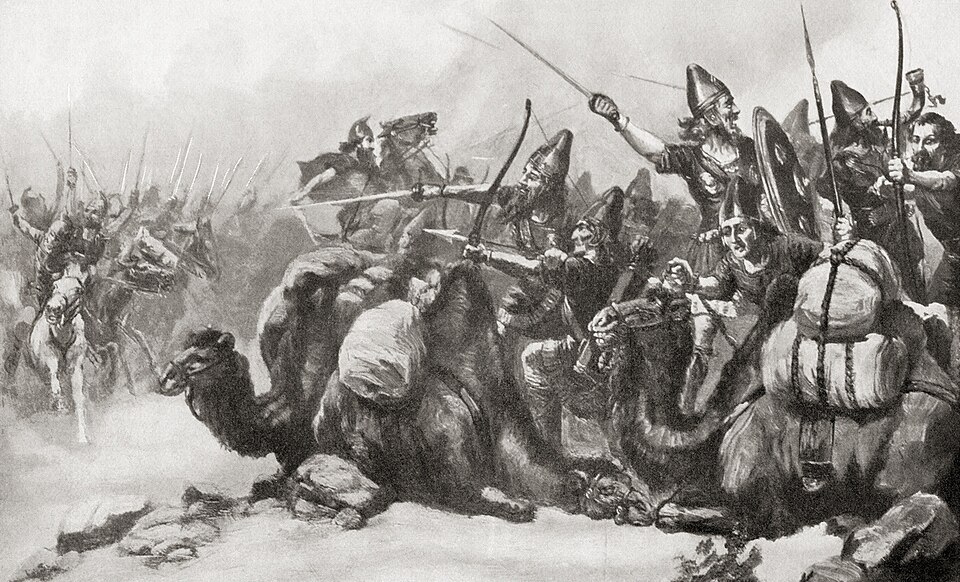
Herodotus explains the Persian victory outside Sardis through the deployment of baggage camels against the Lydian cavalry. The horses, disturbed by the animals’ appearance and smell, become ineffective; the Lydians dismount and continue fighting before retreating into the city. This is a memorable account of tactical improvisation, but its precise mechanism is not independently established by the evidence considered here. It belongs to the reported narrative of the battle, not to a securely recoverable operational record. The capture of Sardis is similarly associated with an individual act of observation. According to Herodotus, a soldier named Hyroeades notices a Lydian descending a supposedly inaccessible section of the acropolis to retrieve a fallen helmet. He later climbs the same route, followed by other attackers. After a siege said to have lasted fourteen days, the city falls and is plundered.
Archaeology supplies a different and more immediate perspective. Excavations at Sardis have uncovered burned buildings, damaged fortifications, weapons, and human remains associated with the mid-sixth-century destruction conventionally identified with the Persian capture. The evidence establishes a violent rupture in the city’s history. It cannot verify the camel stratagem, identify the route taken by Hyroeades, or confirm the exact duration of the siege. Cahill’s interpretation of the destruction makes clear how much is lost when conquest is described only as the transfer of a kingdom. Houses burned, fighting reached the defended urban area, and bodies were left among the debris. Some remains have been interpreted as those of defeated defenders, although individual identities cannot be securely recovered. The capture of Sardis was an imperial success experienced locally through death, destruction, and displacement.⁴
Croesus’s fate is more difficult to establish. Herodotus describes his capture, placement on a pyre, rescue, and subsequent position as an adviser to Cyrus. The scene brings the king’s reversal of fortune to its climax: the man who had equated wealth with happiness is forced to recognise the insecurity of both. Other traditions differ. In Bacchylides’ version, summarised by Cahill, Croesus prepares his own pyre to escape captivity and receives miraculous deliverance. The variations show how quickly his defeat became material for religious and moral interpretation. His survival and later advisory role should therefore not be used as straightforward evidence for Cyrus’s treatment of defeated monarchs. The end of Croesus’s independent kingship is secure; the details of his subsequent life are not.⁵
From Lydian Kingdom to Persian Province

The fall of Sardis removed the Lydian monarchy, but it did not instantly settle the political future of every community previously connected to it. Herodotus describes the Ionian and Aeolian cities seeking an agreement with Cyrus on terms comparable to those they had held under Croesus. Their request reveals the distinction between the collapse of a dominant kingdom and the negotiation of new obligations by its former dependants. Resistance also emerged at Sardis. In Herodotus’s account, Cyrus entrusted the Persian Tabalus with the citadel and assigned the Lydian Pactyes responsibility for conveying the royal treasure. Pactyes then organised a revolt, prompting further Persian military intervention. Whatever uncertainty surrounds particular details, the narrative does not describe effortless incorporation. It presents conquest as the beginning of another struggle over authority, resources, and compliance.
Subsequent campaigns by Persian commanders extended control over communities in western Anatolia. The conquest of Lydia and the subjection of the coastal cities thus formed connected but distinguishable processes. Cyrus’s victory created the opportunity for expansion towards the Aegean; the establishment of effective power required additional operations and local settlements.⁶ Sardis nevertheless retained its administrative importance. Under Persian rule, it became the capital of the region known in imperial terminology as Sparda and a principal centre of government in the west. Its continued prominence illustrates a practical feature of imperial expansion: established centres could be appropriated because their location and existing networks made them useful to the new rulers.
This continuity should not be mistaken for an unchanged political order. Sardis now belonged to a larger system of royal authority, provincial government, military demands, and resource collection. Nor should the better-documented arrangements of later Achaemenid rule be projected wholesale onto the first years after the conquest. The city’s eventual role as a satrapal capital establishes the durability of its importance, not the precise administrative measures Cyrus introduced immediately after victory.⁷ The cultural consequences are equally difficult to reduce to a choice between replacement and preservation. Elspeth R. M. Dusinberre’s study of Achaemenid Sardis argues that imperial power worked through an existing society while changing its relationships and material practices. Persian influence need not appear only as imported objects or conspicuously Iranian buildings. It could also operate through local production, altered patterns of consumption, and new ways of expressing status.
 |  |
|---|
In this interpretation, people of different backgrounds participated in an elite culture that drew on Iranian, Lydian, and Greek traditions. Objects such as seals, jewellery, and tableware could communicate affiliation with the imperial order without requiring their users to abandon every local practice. Political incorporation therefore involved the creation of new social relationships as well as obedience to foreign officials.
The argument has limits. Andrew Ramage’s review welcomes Dusinberre’s reassessment while challenging some reconstructions of the city’s architecture and infrastructure. He warns that incomplete excavation makes it easy to move from possible arrangements to an overly confident account of the urban landscape. His criticism does not erase the evidence for cultural interaction; it distinguishes that broader interpretation from particular reconstructions that remain uncertain.
A further chronological limitation matters here. Material reflecting generations of Achaemenid rule cannot be treated as the immediate result of a policy devised by Cyrus. It reveals the longer history that his conquest made possible. The initial military occupation, subsequent provincial consolidation, and development of new cultural practices must remain related but separate stages of the explanation.⁸
Lydia consequently offers no simple model of either benevolent accommodation or unrelieved destruction. The evidence supports a violent capture, the suppression of resistance, continued use of an established political centre, and substantial interaction over the following centuries. These were not mutually exclusive features of Persian rule. Coercion established the new hierarchy; administration and participation helped reproduce it.
 |
|---|
Cyrus’s victory over Croesus changed the geographical reach of his power. After the overthrow of Astyages, the defeat of another major monarchy extended Persian influence into western Anatolia and created a direct relationship with the Aegean cities. Yet the significance of the conquest lies as much in what followed the battle as in the battle itself. The capture of Sardis won a kingdom; turning that victory into durable dominion required further warfare, the appropriation of existing institutions, and the gradual formation of new relationships between imperial authority and local society.
Bibliography
Herodotus,Histories1.6, 1.26–28, and 1.69–75, for Lydian expansion, relationships with Greek communities, and the motives attributed to Croesus. The account was consulted in English translation; the proposed motives are distinguished here from independently established court deliberations.[gutenberg][yorku]
Nicholas Cahill, “The Persian Sack of Sardis,” inThe Lydians and Their World, for the campaign chronology and the argument favouring Lydia. Robert Rollinger’s alternative interpretation is represented by his accessible paper extract and Astrid Nunn’s scholarly notice. Rollinger and Andreas Kellner’s later position is represented by the available abstract of “Once More: The Nabonidus Chronicle (BM 35382) and Cyrus’ Campaign in 547 BC,”Ancient West & East18 (2019), 153–176; the complete article was not consulted. The damaged Babylonian text was not independently collated.[sardisexpedition][achemenet][journals.openedition][academia]
Herodotus,Histories1.71–83, for the offensive in Cappadocia, the battle at Pteria, Croesus’s withdrawal, anticipated allied assistance, and Cyrus’s pursuit. The strategic explanation follows the sequence reported by Herodotus rather than claiming independent knowledge of either king’s decisions.[yorku]
Herodotus,Histories1.80–84, for the camels and capture narrative; Cahill, “The Persian Sack of Sardis,” consulted in full, for the excavation evidence and its interpretation. Archaeological support for violent destruction is not treated as confirmation of every literary detail.[yorku][sardisexpedition]
Herodotus,Histories1.85–91, for Croesus’s capture and rescue; Cahill for comparison with Bacchylides,Ode3. Bacchylides was accessed through Cahill’s discussion rather than independently consulted in a critical edition.[yorku][sardisexpedition]
Herodotus,Histories1.141 and 1.153–176, for negotiations with the Greek cities, the revolt of Pactyes, and subsequent Persian campaigns. These episodes are used as the ancient narrative of consolidation, not as contemporary administrative documentation.[gutenberg][yorku]
Elspeth R. M. Dusinberre,Aspects of Empire in Achaemenid Sardis(Cambridge University Press, 2003), accessible opening chapter, for Sardis’s place within imperial government, Sparda, and the use of existing centres. The discussion distinguishes mature provincial structures from the less securely documented arrangements immediately following conquest.[catdir.loc]
Dusinberre’s accessible opening chapter supplies her interpretive framework. Andrew Ramage’s review,Bryn Mawr Classical Review2004.02.21, consulted in full, provides an explicit assessment of its strengths and limitations. The full monograph was not consulted, and its later chapters are not represented here as having been read directly.[catdir.loc][bmcr.brynmawr]
Continue this collection
Achaemenid Empire — Article 4 of 6