
 Iran Chronicle
Susa - The Making of an Early City
Marie-Lan Nguyen (2009)
Susa emerged on the Susiana plain of southwestern Iran during the late fifth millennium BCE, within a landscape already occupied by farming communities. Its development brought together monumental construction, accomplished crafts, regional connections, and increasingly elaborate procedures for administering goods.
Susa's transformation into an urban centre cannot be reduced to a founding date or a single invention. Archaeologists reconstruct that process through buildings, burials, pottery, seals, and accounting devices, each illuminating different aspects of a society whose earliest inhabitants left no readable historical narrative. It's importance lies in the convergence of these forms of evidence, and the questions they raise about how communities began to organise activities beyond the scale of individual households (Henrickson, 1991; Wright, 2010).
From Settlement to Regional Centre
Susa occupied the lowlands of present-day Khuzestan, west of the Zagros Mountains. The agricultural plain connected it with neighbouring settlements, while routes towards the mountains and Mesopotamia placed it within a wider geographical network. This was not an empty landscape awaiting an urban founder. Earlier communities had developed farming, animal husbandry, and craft production. Population centres such as Chogha Mish already possessed substantial settlement histories. Susa’s emergence therefore belonged to a regional reorganisation, not the sudden appearance of complex society where none had existed previously.
The early development of Susa is conventionally described through archaeological phases rather than named rulers or dynasties. "Susa I"encompasses the first settlement and its distinctive painted pottery;"Susa II"covers much of the subsequent fourth-millennium development associated with increasingly close Mesopotamian connections. Absolute dates differ between published chronological schemes, so these phases are more reliable guides than an apparently precise year of foundation. Nor should the familiar designation “Elamite” be projected uncritically onto this earliest community: later political and linguistic identities cannot simply be assumed for its founders.
 |  |  |
|---|
One of Susa I’s most consequential achievements was the construction of an elevated monumental platform. Whatever its precise function, building it required considerable labour, materials, and coordination. The structure physically distinguished a part of the settlement from ordinary ground-level activity, making it evidence for a capacity to organise work beyond small domestic projects. The remains above it are fragmentary, however. A temple has been proposed, but the identification is not conclusive; neither a named deity nor a particular form of priestly government can be recovered from the platform alone (Henrickson, 1991).1
This distinction matters because monumental architecture is often used to tell an overly complete political story. A large building demonstrates that resources were assembled, but does not by itself reveal whether labour was obligatory, negotiated, or associated with periodic communal gatherings. Early Susa may have exercised ceremonial importance beyond the scale of its permanent population. Its significance as a meeting place and regional centre need not have depended initially on the dense residential occupation associated with later cities.
 |  |  |
|---|
The cemetery provides another view of this community. Its burials contained pottery, copper objects, and other goods, including the finely painted vessels for which early Susa is particularly well known. Bowls, jars, and tall beakers combined controlled forms with geometric patterns and highly stylised animals. These objects reveal accomplished manufacture, but their burial context is essential: vessels selected for funerary use cannot automatically represent the equipment of everyday kitchens. Their survival tells us both about ceramic skill and about choices made in treating the dead. Interpreting differences between graves is more difficult. Unequal quantities or types of objects may reflect status, but other distinctions such as age, social affiliation, ritual practice, or the circumstances of burial could also matter. Early excavation and incomplete contextual records restrict what can be reconstructed. Frank Hole’s study of the cemetery and Henrickson’s regional synthesis both underline the need to treat burial practices as a problem of interpretation, rather than translate richer graves directly into a fixed hierarchy of rulers and subjects (Hole, 1992; Henrickson, 1991).
 |  |  |
|---|
The polished objects of the cemetery also direct attention towards less visible work. Potters prepared clay and controlled firing; metalworkers transformed materials obtained beyond the immediate alluvial plain. The people supporting the settlement cultivated crops, kept animals, processed food, and maintained buildings. Although individual households are less securely recoverable than monumental features and selected artefacts, Susa’s development depended on this wider material economy. Ceremonial prominence did not remove the practical demands of sustaining a community. Its surrounding settlements were equally important. Wright places late fifth-millennium Susa within networks extending towards the Zagros foothills, examining smaller sites and their connections with the lowland centre. Seals and sealings are relevant because they preserve traces of regulated access to containers or goods. Their distribution suggests relationships more structured than occasional encounters, while leaving debate about the authority behind them. Susa was not an isolated achievement: its regional position depended on interactions with communities whose own roles and strategies varied (Wright, 2010).2
Recognising an Early City
An observant reader might ask, What, then, justifies describing Susa as an early city? Size alone is insufficient. Archaeologists look for combinations of settlement concentration, differentiated activities, monumental investment, institutional coordination, and relationships with a supporting region. These characteristics do not necessarily appear together, and their identification depends on the survival and exposure of evidence. At Susa, the argument for urban organisation becomes stronger during the fourth millennium because several developments can be studied in relation to one another. That relationship owes much to excavation method. Early investigations recovered enormous quantities of material but often lacked the stratigraphic control required to place objects securely within successive occupations. Later soundings on the Acropole and Ville Royale sought to establish dependable sequences. These excavations made it possible to distinguish changes through time rather than construct a history from attractive objects grouped by appearance. Even so, their restricted areas cannot provide a complete plan of the early settlement (Le Brun, 2019).3
 |  |  |
|---|
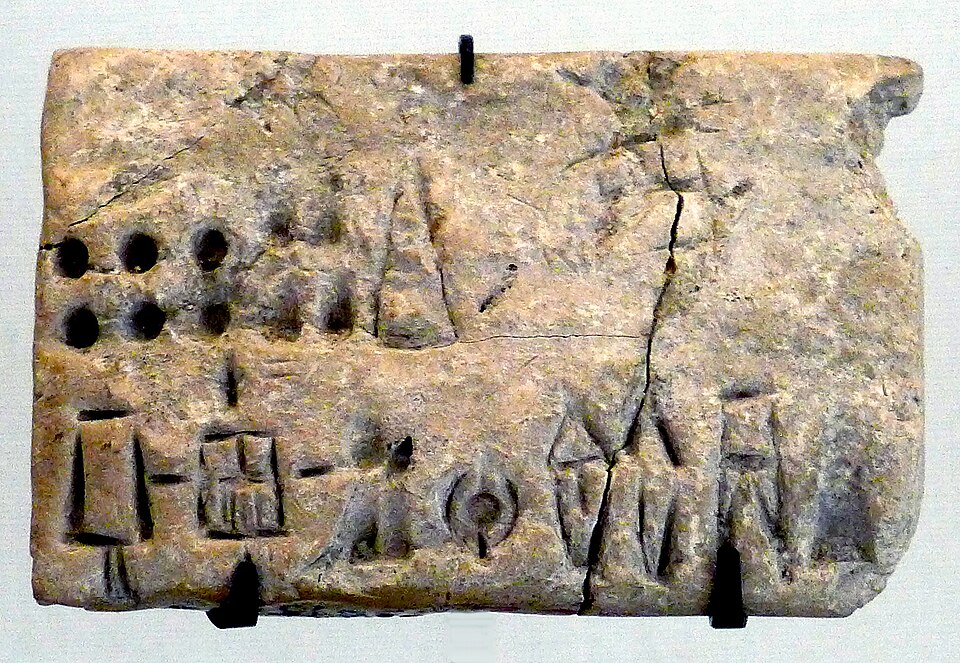
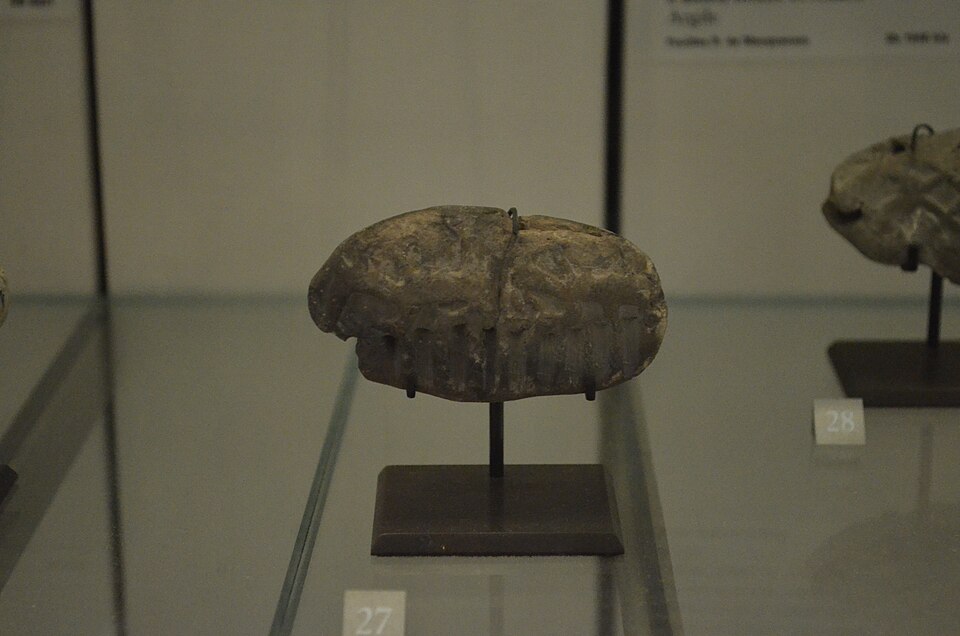
During Susa II, mass-produced bevelled-rim bowls became a characteristic component of the pottery assemblage. Their recurrence contrasts with the elaborate painted vessels prominent in Susa I. This was not simply a decline in artistic quality: the production and use of numerous relatively standard containers raises different questions about demand, distribution, and organised consumption. Their presence fits an economy involving repeated transactions or collective activities, although it does not independently identify who received their contents or under what conditions. The administrative sequence offers more direct evidence of institutional practice. In the Acropole excavation, cylinder seals appeared before clay envelopes containing counters. Rolled across soft clay, a cylinder seal left a continuous design; such impressions could mark responsibility or authorise a transaction. Counters enclosed within sealed clay envelopes represented quantities, while impressions on some envelopes recorded information on their outer surfaces. Le Brun’s sequence documents increasingly elaborate arrangements for controlling goods and information, numerical tablets subsequently offered another way to preserve quantities without relying on a sealed collection of enclosed objects.
These devices make "administration"tangible. They imply situations in which memory and personal familiarity were insufficient, or in which an enduring record was useful. Goods could be counted, access restricted, and responsibility marked. What remains harder to reconstruct is the exact institutional setting. An accounting device does not announce whether its user represented a temple, a household, or another organisation; it certainly does not supply a complete constitution for an early state. Seal imagery adds another perspective. Scenes of animals, work, and organised human activity provide representations of social concerns, but they are not straightforward illustrations of events. Images may express authority, ideal order, or ritual meaning rather than reproduce daily life. The specialist studies assembled inThe Royal City of Susaaccordingly examine seals as both working administrative objects and designed images. Their practical and representational functions should be considered together (Harper, Aruz, and Tallon, eds., 1992).4
 |  |  |
|---|
Susa II further displayed substantial connections with southern Mesopotamia, particularly the cultural world associated with Uruk. Pottery, cylinder seals, and accounting practices place Susa within developments extending beyond the Susiana plain. Le Brun describes this phase as participation in a Mesopotamian cultural and socio-political sphere. Yet shared practices are not identical to proof of political subordination. They do not establish, by themselves, that Uruk founded Susa, conquered it, or governed it continuously (Le Brun, 2019). Regional evidence likewise resists a story in which Susa simply absorbed every neighbour. Le Brun identifies it alongside Chogha Mish and Abu Fanduweh as a major centre during this period. Urban development involved relationships among substantial settlements as well as between centres and villages. The surviving record cannot reduce those relationships to uninterrupted cooperation or permanent rivalry.
Towards the end of the fourth millennium, Susa’s material culture and regional connections changed again. Proto-Elamite tablets appeared alongside changes in pottery and seal imagery, connecting the settlement more strongly with sites across the Iranian plateau. Evidence suggests a reorganisation and reduction of occupation rather than uninterrupted expansion. The causes remain uncertain, and the transition is incompletely preserved. These changes belong to the next article’s discussion of writing, but they already demonstrate that becoming urban did not guarantee continuous growth. Susa’s emergence as a city was therefore a cumulative, uneven process. Monumental construction and burial practices reveal early communal investment; craft production and regional relationships disclose its material foundations; administrative objects show increasingly formal methods of organising goods and responsibility. None explains the transformation alone. Together, they reveal a settlement whose significance grew through its capacity to coordinate people and activities across several scales—without requiring us to imagine a fully formed state at its foundation.
Editorial note
Chronological schemes differ, so in this article we have used approximate dates and archaeological phases rather than a precise founding year. The museum catalogue was consulted through an OCR transcription, which is unsuitable for unchecked quotations or page-specific citations; Wright’s article was only partly retrieved. The functions of the early platform, the organisation behind administrative objects, and the causes of late fourth-millennium change remain interpretive questions, not settled facts.
Footnotes
https://www.iranicaonline.org/articles/chalcolithic-era-in-persia/
Return to referencehttps://www.persee.fr/doc/paleo_0153-9345_2010_num_36_1_5308
Return to referencehttps://books.openedition.org/momeditions/8026
Return to referencehttps://archive.org/stream/RoyalCityofSusaAncientNearEasternTreasuresintheLouvre/RoyalCityofSusaAncientNearEasternTreasuresintheLouvre_djvu.txt
Return to reference
Sources & Further Reading
- Harper, Prudence O., Joan Aruz, and Françoise Tallon, eds. 1992 · The Royal City of Susa: Ancient Near Eastern Treasures
- Henrickson, Elizabeth F. 1991 · Chalcolithic Era.” Encyclopaedia Iranica V/4: 347–353.
- Hole, Frank. 1992 · The Cemetery of Susa: An Interpretation.
- Le Brun, Alain. 2019 · Susa at the Turn of the 4th and 3rd Millennia In The Iranian Plateau during the Bronze Age: Development of Urbanisation, Production and Trade, pp. 101–108. Lyon: MOM Éditions
- Wright, Henry T. 2010 · The Zagros Frontiers of Susa during the Late 5th Millennium Paléorient 36/1: 11–21