 Iran Chronicle
Remembering Cyrus: Pasargadae, Kingship, and a Founder’s Death
This article examines how Cyrus’s authority was represented after his death through Pasargadae, competing accounts of his final campaign, and Alexander’s reported restoration of his tomb. It argues that these sources address a common problem: how founding achievement could authorise subsequent rule without guaranteeing its legitimacy. Archaeological context, disputed inscriptional chronology, and literary construction are assessed separately before comparison. The resulting picture is not of an unchanged royal image, but of selective claims upon a founder whose achievements could support dynastic continuity, expose the limits of conquest, or distinguish legitimate custody from possession.
Cyrus left an empire, but no uncontested account of what its foundation meant. At Pasargadae, his successors inherited buildings whose construction and interpretation continued beyond his lifetime. Greek writers made his death an assessment of his achievements. Alexander, according to Arrian, subsequently asserted responsibility for the protection of his remains. The question linking this evidence is not whether Cyrus was remembered favourably, but how his authority became available to others. “Memory” here denotes identifiable acts of representation and custodianship: naming Cyrus in inscriptions, narrating his final decisions, and maintaining his burial. These activities do not establish a uniform collective remembrance. Nor does their comparison require the assumption that Greek authors knew the monuments or that architecture and narrative expressed a coordinated programme. Archaeological remains establish construction and spatial relationships; inscriptions make royal claims; literary accounts organise events into judgements. Their evidential functions must remain distinct.
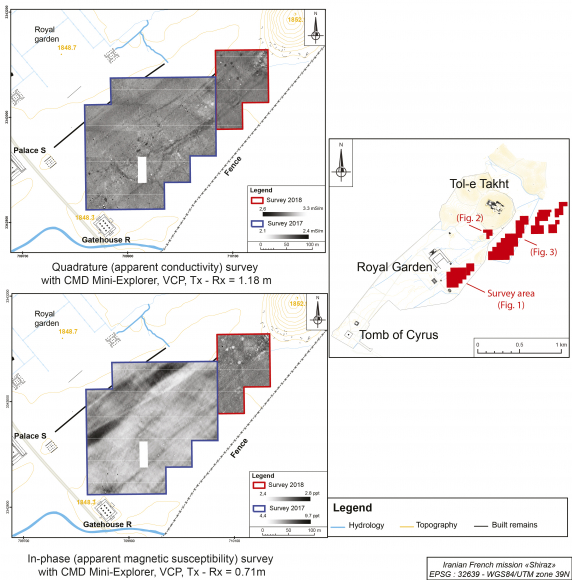
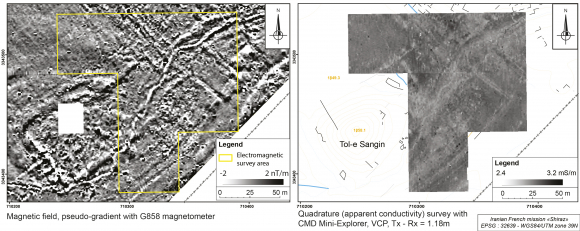
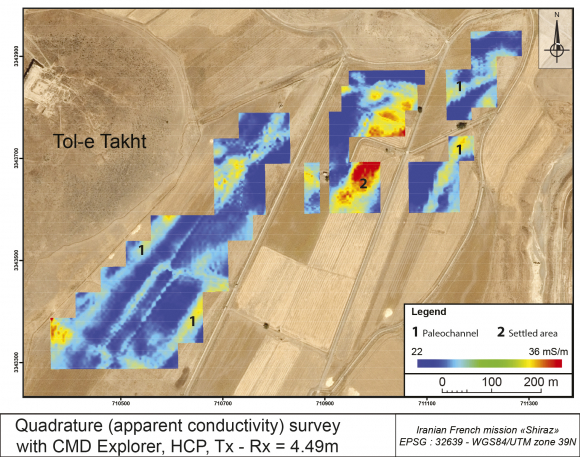
Pasargadae’s surviving monuments once encouraged images of an isolated palaces dispersed across an open plain. Survey has substantially revised that impression. The Iranian-French investigations published by Christophe Benech, Rémy Boucharlat, and Sébastien Gondet identified extensive spatial organisation linking monumental buildings, water management, and less conspicuous occupation. Their results include a large basin beside Palace S and a bridge, along with boundaries, circulation routes, and additional structures. The residence was an organised landscape, not simply an assemblage of detached buildings.
The distinction between observation and reconstruction matters. The basin’s outline and associated anomalies support a substantial hydraulic installation; proposed sluices and internal arrangements remain interpretations. Agricultural disturbance complicates the separation of ancient features from later land use, while survey alone cannot assign every installation to Cyrus. Nevertheless, the report establishes that the familiar standing monuments represent only part of the royal environment.¹
 |  |  |
|---|
The palace garden illustrates the risks of moving too quickly from physical arrangement to political symbolism. Excavated stone channels define two rectangular areas. A further division into four has been reconstructed partly from the position of the royal seat and the presumed sightline from Palace P. David Stronach associated that arrangement with the later fourfold garden and entertained a connection with sovereignty over the world’s “four quarters.” Fiona Kidd’s reassessment accepts the importance of the landscaped residence but questions the archaeological basis of the fourfold reconstruction. The surviving channels do not themselves establish four quadrants. She also notes the difficulty of deriving a comprehensive ideology of gardening from a royal visual and textual repertoire in which explicit horticultural imagery is comparatively limited. The disagreement concerns the strength of the inference, not the existence of deliberate planning.²
The argument here therefore rests on the better-supported relationship between monumental architecture and managed space. Pasargadae displayed the capacity to organise water, materials, specialist labour, and ceremonial movement. Its techniques and imagery incorporated western Iranian, Mesopotamian, Anatolian, and Egyptian precedents. Such incorporation demonstrates the resources available to the expanding monarchy; it does not independently establish either an ideology of equal inclusion or an entirely new architectural tradition. A more direct claim about succession appears in the inscriptions conventionally designated CMa and CMc. CMa identifies its speaker as Cyrus, king and Achaemenid. If composed during his reign, it records his own dynastic designation. If added under Darius, it makes the founder speak within a genealogy useful to a successor.
CMa and CMcare scholarly catalogue labels for inscriptions naming Cyrus at Pasargadae. They are not ancient names or titles.
The letters mean:
C = Cyrus.
M = Murghab, the plain in which Pasargadae stands.
a or c = the particular inscriptional text being distinguished from others at the same site. These letters do not establish chronological order.
The later attribution combines several arguments:
the completion of parts of Pasargadae after Cyrus,
The relationship between inscription and architectural finishing,
and the disputed interpretation of Darius’s statement about writing in Old Persian at Bisotun.
Matt Waters accepts the Darius attribution and treats the inscriptions as part of his effort to connect himself with Cyrus’s royal line. Crucially, however, Waters does not equate ideological construction with the invention of every familial relationship. His proposed connection through Cassandane, Cyrus’s wife, allows genuine kinship to coexist with the selective presentation of descent. Reza Zarghamee contests both the necessity of dating the inscriptions to Darius and the stronger claim of a dynastic rupture. He questions whether the Bisotun passage establishes the invention of the script, discusses arguments for earlier features in the Pasargadae texts, and interprets the absence of Achaemenes from Cyrus’s Babylonian inscriptions through their local conventions. These explanations challenge the inference that silence in one setting proves the absence of a dynastic affiliation in another.³ Neither position can be resolved by asking whether Darius “needed legitimacy”: that motive could explain an intervention but cannot date it. The combined architectural and epigraphic case makes Darius’s participation a persuasive working interpretation, not an independently established fact about every text. The conclusion must consequently be conditional. If the inscriptions are his additions, Pasargadae materially demonstrates the retrospective definition of Cyrus’s ancestry. If they are contemporary with Cyrus, that particular example disappears. The broader argument survives, but it cannot claim the same epigraphic support.
Death as a judgement on founding power
Cyrus’s reign conventionally ends in 530 BCE, although older scholarship sometimes gives 529. The chronological framework and the circumstances of death have different evidential foundations. The agreement on an approximate date does not corroborate a particular battle narrative. Herodotus, writing in the later fifth century BCE, is already separated from the event by roughly a century. Ctesias and Xenophon wrote later still. Their accounts cannot be treated as three independent eyewitness reports.⁴
Herodotus places Cyrus’s death within a final attempt at expansion against the Massagetae. The narrative’s decisive feature is the relationship between warnings and interpretation. Tomyris advises Cyrus to remain within his own country. Croesus reminds him that prosperity cannot remain secure, yet supplies the strategy that encourages the invasion. Cyrus then mistakes a dream of Darius’s future supremacy for evidence of an immediate conspiracy.
Herodotus explicitly corrects the king’s reading: the dream announces his approaching death and the eventual transfer of power.
The founder can conquer territories but cannot correctly interpret the limits of his own life. His earlier success contributes to the error: Herodotus identifies repeated victory and extraordinary ancestry among the reasons for his confidence. The narrative therefore makes the final campaign a test of whether accumulated power produces sound judgement. Tomyris’s treatment of the corpse completes that reversal. By placing Cyrus’s head in blood, she turns a successful conqueror’s appetite into the explanation of his defeat. The scene also gives the bereaved ruler authority to pronounce judgement over him. This is more specific than a general lesson about pride: it contests the extension of imperial mastery into a country whose ruler has repeatedly offered withdrawal. Herodotus nevertheless acknowledges alternative accounts and declares this one the most credible. His selection is itself evidence of an existing competition over Cyrus’s ending. The narrative’s moral coherence does not prove its invention, but neither does his preference authenticate the speeches, mutilation, or sequence of events. Robert Faulkner’s interpretation accordingly treats Cyrus as a gifted but fallible ruler, rather than reducing Herodotus’s portrayal to either condemnation or admiration.⁵
Ctesias offers a different solution. In the account preserved through Photius, Cyrus is mortally wounded during a campaign against the Derbices, but his forces subsequently prevail with allied assistance. The interval before death permits arrangements for succession and the distribution of authority. Cambyses then sends the body to Persia. Unlike Herodotus’s ending, this account separates the ruler’s bodily defeat from the success of his undertaking. Death does not invalidate conquest; the wounded founder remains capable of ordering the political future. Yet its transmission requires particular caution. Ctesias’s court experience may have exposed him to Persian traditions, but the surviving narrative is a later epitome, not his complete text. Andrew Nichols argues that Ctesias should be examined as a possible witness to court traditions rather than dismissed because his work contains fabulous material. That approach restores a category of evidence; it does not validate individual episodes. Nor does Ctesias’s disagreement with Herodotus demonstrate independent access to the event itself.⁶
A recent reconstruction by Morteza Arabzadeh Sarbanani prefers Ctesias because his victorious Persians and returned royal body appear compatible with Persian control in the east and burial at Pasargadae. The comparison usefully introduces evidence outside the narrative tradition. Its discriminatory force is limited, however. Later imperial possession does not prove victory in a particular earlier battle, and the existence of a burial does not establish how the body was recovered. Compatibility supplies a reason to retain an account among the possibilities, not sufficient grounds to select it as established history.
Xenophon shifts the question from campaign outcome to the assessment of a completed life. In Cyropaedia-8.7, Cyrus recognises his approaching death, assembles his heirs and companions, and explains why he should be remembered as fortunate. The scene grants him the interpretative control denied to Herodotus’s Cyrus. Paula Winsor Sage identifies its sustained engagement with the Solon–Croesus discussion in Herodotus. Cyrus reviews his health, achievements, friends, country, and surviving children against a standard that postpones judgement until life’s end. The speech also draws on encomiastic conventions: its selection and arrangement of virtues invite an assessment resembling a funeral tribute.
The achievement remains qualified. Cyrus’s sons survive, but their future happiness is not secured; the following chapter depicts deterioration after his death. As Sage observes, the founder’s ability to create order does not demonstrate that his successors can sustain it. Her analysis concerns literary construction, not the historicity of the deathbed scene, and it depends partly on reading the disputed final chapter as Xenophon’s. Even without that chapter, the speech’s retrospective ordering prevents its use as a recoverable royal testament.⁷ These accounts are not alternative transcripts from which a composite ending can be assembled. They pose competing tests. Herodotus asks whether conquest recognises limits; Ctesias preserves effective succession despite a fatal wound; Xenophon asks whether a ruler can complete a fortunate life and transmit its political achievements. Their literary purposes constrain historical reconstruction without making historical content impossible.
Custody of the founder
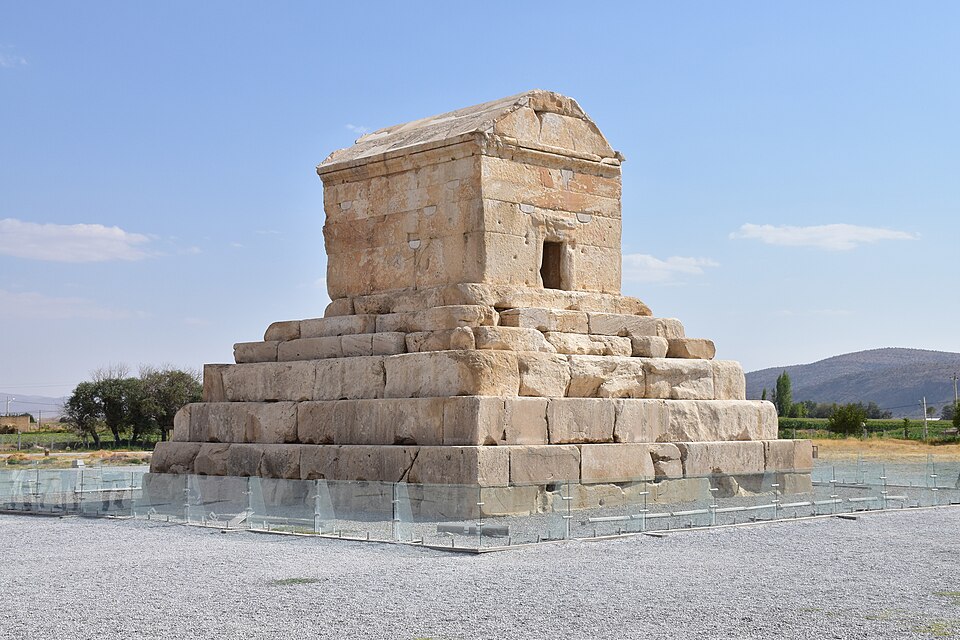
The tomb offers a firmer identification than any detailed account of the death, but not an answer to it. Its gabled chamber, narrow entrance, and stepped base correspond sufficiently with classical descriptions to support identification with Cyrus’s monument. Its construction also belongs within the architectural setting of early Pasargadae. Neither an intact burial assemblage nor a surviving epitaph naming Cyrus establishes the case. Antigoni Zournatzi distinguishes the strong identification from uncertainty about architectural antecedents and the missing inscription. Western Anatolian construction and chamber parallels do not explain every feature of the monument; proposed Mesopotamian precedents for its base likewise do not account for the whole. No single derivation is needed to establish its place in the royal landscape.⁸
Arrian’s account of Alexander’s intervention requires a different distinction: between the surviving author and his earlier source. Writing in the second century CE, Arrian explicitly attributes the episode to Aristobulus, a participant in Alexander’s expedition. Aristobulus’s reported responsibility for the repairs gives the narrative an unusually close connection to a named actor. It does not make Arrian’s version an unmediated account of either the tomb’s original furnishing or Cyrus’s funeral. The description presents an institution of continuing royal custody. Magian guardians inherited their duties and received provisions. Within the chamber stood a golden coffin, furniture, textiles, garments, and ornaments. The contrast between this account and the restrained exterior cautions against making architectural simplicity evidence of an austere royal burial.
Alexander reportedly found the tomb plundered and the remains disturbed. He ordered Aristobulus to restore the body, repair the furnishings, replace missing objects, and seal the entrance. He also tortured the guardians in an unsuccessful attempt to identify the perpetrators, then released them.
What the text establishes is a claim to protective authority backed by coercion. Arrian explicitly reports distress at the violation; he does not explicitly identify restoration as an accession ceremony. The broader inference is that the conqueror appears as the agent capable of restoring an order others have violated. That representation can support a claim to rightful rule without proving a particular constitutional succession or a single private motive. N. G. L. Hammond’s distinction between Alexander’s claims to rule Asia and possession of the Persian throne is useful here, although only the accessible extract and published notes of his article were consulted. His discussion cautions against treating every association with Cyrus as proof that Alexander simply assumed the Persian kingship. The narrower conclusion does not require that assumption: repairing the founder’s monument demonstrates custody over a politically valuable past.⁹
The epitaph reported by Arrian performs a related operation. Cyrus identifies himself as the founder of Persian empire and asks the passer-by not to begrudge him his monument. Because no corresponding inscription survives, those words must remain a transmitted text, not an authenticated utterance recovered from the building. Within the account, their effect is nevertheless clear: the founder addresses later possessors of power and makes protection of his resting place an obligation. A brief later comparison defines the limits of this continuity. The monument’s attribution to the Mother of Solomon and incorporation into a medieval religious setting show that preservation could continue after identification changed. Reverence for a building is not equivalent to remembrance of its original occupant. The ancient evidence examined here concerns more specific acts: the dynastic naming of Cyrus, judgements on his ending, and the asserted right to protect his remains.¹⁰
These acts share a problem, not a uniform solution. A founder’s achievements could authorise a successor, but ancestry remained open to formulation and dispute. Successful conquest could establish an empire, but not exemption from mortality or failure. Possession of the tomb could enable a conqueror to perform guardianship, but not demonstrate that he inherited every aspect of the founder’s office.
Pasargadae and the death narratives therefore illuminate the limits as well as the usefulness of Cyrus’s posthumous authority. Their comparison does not recover an original, uncontested royal image. It shows how the distinction between founding power and legitimate continuation repeatedly had to be made.
Bibliography
Christophe Benech, Rémy Boucharlat, and Sébastien Gondet, “Organisation et aménagement de l’espace à Pasargades: reconnaissances archéologiques de surface, 2003–2008,”ARTA2012.003, especially pp. 2–8 and 13–28. Figure 1, p. 3, supplies a general site plan; figures 6–11 document the central area and distinguish observed anomalies from reconstruction. The report was consulted directly, rather than through a reference summary.
Fiona Kidd, “Ideas of Empire: The ‘Royal Garden’ at Pasargadae,” Metropolitan Museum of Art, 29 July 2013. Kidd directly distinguishes the excavated two-part arrangement from the inferred fourfold division and discusses the limitations of garden symbolism. Stronach’s 1989 and 1990 studies were not independently consulted in their original publications; their reconstruction is assessed here through Kidd’s explicit discussion, not presented as a fresh examination of those articles.
Matt Waters, “Cyrus and the Achaemenids,”Iran42 (2004), pp. 91–102, especially pp. 91, 94–98; Reza Zarghamee, “Cyrus, Darius, and the Early History of the Achaemenid Dynasty,” appendix I toDiscovering Cyrus, especially pp. 436–442 in the author-uploaded excerpt. Zarghamee’s discussions of Hallock and Vallat were consulted as his presentation of their arguments, not as independent readings of their publications. CMa and CMc are the inscription identifiers used in both treatments.
Waters, “Cyrus and the Achaemenids,” p. 93, gives the conventional reign as 559–530 BCE and stresses its chronological gaps. Morteza Arabzadeh Sarbanani, “How Did Cyrus the Great Die?”The Ancient Near East Today12.4 (2024), surveys the competing endings. The precise circumstances are not independently dated by the material examined here.
Herodotus,Histories1.201–214, translated by A. D. Godley, especially 1.204, 207, 209–210, and 214; Robert Faulkner, “Cyrus iiia. Cyrus II as Portrayed by Xenophon and Herodotus,”Encyclopaedia Iranica. The analysis of warning and misinterpretation follows the explicit narrative contrasts, not an assumption that every element serves a single moral.
Ctesias, as summarised by Photius,Persica, sections 7–9, translated by J. H. Freese; Andrew Nichols,The Complete Fragments of Ctesias of Cnidus: Translation and Commentary with an Introduction, PhD dissertation, University of Florida, 2008, relevant introductory discussion, especially pp. 8–17; Arabzadeh Sarbanani, “How Did Cyrus the Great Die?” The criticism of the latter’s inference from later territorial possession and burial is this article’s assessment.
Xenophon,Cyropaedia8.7, translated by Walter Miller; Paula Winsor Sage, “Tradition, Genre, and Character Portrayal:Cyropaedia8.7 andAnabasis1.9,”Greek, Roman, and Byzantine Studies32.1 (1991), pp. 61–79, especially pp. 64–69 and 73–75. Sage explicitly brackets historicity and acknowledges the dispute overCyropaedia8.8.
Antigoni Zournatzi, “Cyrus v. The Tomb of Cyrus,”Encyclopaedia IranicaVI/5 (1993), pp. 522–524. This remains a specialist synthesis rather than an independently reassessed architectural survey. Its distinctions between identification, antecedents, and the unattested epitaph are retained.
Arrian,Anabasis6.29.4–11, translated by Aubrey de Sélincourt; N. G. L. Hammond, “The Kingdom of Asia and the Persian Throne,”Antichthon20 (1986), pp. 73–85, accessible notes 32–33 and 54–55. Hammond’s complete article was not accessible. The hosting website’s claims about Alexander’s intended coronation and the robbers’ political motives are editorial annotations, not statements by Arrian, and have not been adopted.
Zournatzi, “The Tomb of Cyrus”; Benech, Boucharlat, and Gondet, “Organisation,” p. 8, on later occupation and disturbance around the tomb. This brief comparison does not claim a comprehensive history of the medieval sanctuary.
Primary texts in translation
Arrian.Anabasis6.29. Translated by Aubrey de Sélincourt.
Ctesias.Persica, as summarised by Photius, sections 7–9. Translated by J. H. Freese.
Herodotus.Histories1.201–214. Translated by A. D. Godley.
Xenophon.Cyropaedia8.7. Translated by Walter Miller.
Editorial note
This is a comparative study of published evidence, not a new excavation report or epigraphic edition. The archaeological report, Waters’s article, Sage’s study, and Zarghamee’s relevant appendix were consulted directly. Other access restrictions are identified at the point of use. No independent examination of the monuments, cuneiform inscriptions, or Greek manuscripts was undertaken.
Continue this collection
Achaemenid Empire — Article 7 of 7