 Iran Chronicle
Before Cyrus - Part 1: The Kingdom of Awan and the Dawn of Elamite Power
Centuries before the rise of the Persian Empire, ancient southwestern Iran was shaped by the Kingdom of Awan. Through dynastic record-keeping, fierce rivalry with Mesopotamian empires, and the invention of an indigenous writing system, Awan established the foundations of Elamite political and cultural authority.
The Highland–Lowland Horizon
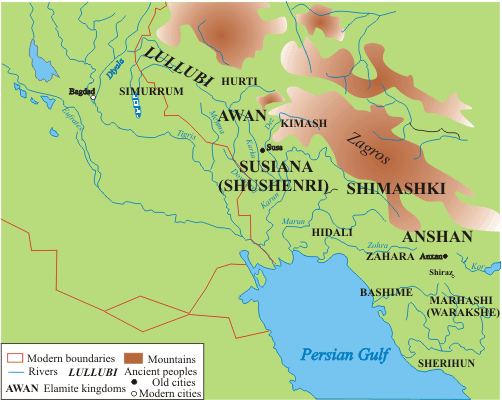
Long before Cyrus the Great established the Achaemenid Empire in the sixth century BCE, the lands of southwestern Iran were governed by an intricate network of highland and lowland societies collectively designated by their Mesopotamian neighbours asElam(NIM.KI). This was never a monolithic, centralised realm. Instead, Elam operated as a dynamic confederation that bound together the fertile alluvial plain of Susiana (modern Khuzestan) with the formidable valleys of the Zagros Mountains, including Anshan in modern Fars and the mountain polities to the north and west.
Among these early highland seats, the kingdom of Awan emerged as the preeminent political force of the mid-to-late third millennium BCE (c. 2400–2100 BCE). Although the exact geographical location of Awan’s capital remains unrecovered likely nestled within the mountainous valleys of modern Luristan or northern Khuzestan. its rulers exerted a decisive influence across the Iranian plateau and down into the lowland metropolis of Susa. Through Awan, early Elamite statehood developed its characteristic dual nature: an ability to command highland resources such as timber, stone, and precious metals while actively governing lowland urban centres and engaging in complex diplomacy with the city-states and empires of Mesopotamia.
The Susa Tablet: Memory in Clay
Much of what is known regarding the royal lineage of Awan comes from a single, unassuming clay tablet discovered during the French archaeological excavations at Susa led by Father Jean-Vincent Scheil and published in 1931 (Musée du Louvre, Sb 17729). |
|  Inscribed during the Old Babylonian period (c. 1800–1600 BCE)—centuries after the kingdom’s collapse—the obverse of the tablet preserves a list of twelve successive monarchs of Awan. |
|---|
Unlike the contemporarySumerian King List, which enumerates regnal years, patronymics, and brief descriptions of dynastic feats, the Awan list provides only royal names separated by lines. The tablet represents an indigenous historical tradition preserved by later Elamite scribes at Susa to trace their dynastic pedigree back to an ancient highland golden age. While the earliest names on the list remain historically obscure, archaeological finds and contemporary Mesopotamian cuneiform records verify that the later rulers of Awan were major geopolitical actors on the ancient Near Eastern stage.
Clashes and Treaties with Akkad
The historical reality of Awan comes into sharp focus during the twenty-fourth and twenty-third centuries BCE, when the imperial expansion of the Akkadian Empire collided directly with the Iranian highlands. Sargon of Akkad (c. 2334–2279 BCE) proudly recorded in his triumphal inscriptions that he campaigned across southwestern Iran, sacking Susa and capturing King Luh-ishan of Awan along with his vassals. Sargon’s successors, Rimush and Manishtushu, continued to conduct military incursions into the Zagros to secure trade routes and raw materials, asserting imperial Akkadian suzerainty over the Susiana plain.
Yet the relationship between Akkad and Awan was not defined solely by conquest. Under Naram-Sin (c. 2254–2218 BCE), warfare gave way to sophisticated interstate diplomacy. Unearthed at Susa and now held in the Louvre (Sb 8833), a large inscribed clay tablet preserves the famousTreaty of Naram-Sin, the oldest preserved diplomatic treaty in world history and the earliest known continuous historical text written in the Elamite language.
TREATY FORMULA (Louvre Sb 8833):
"The enemy of Naram-Sin is my enemy, the friend of Naram-Sin is my friend."
Drafted in an Old Akkadian cuneiform script but composed in Old Elamite, the treaty records an alliance between the Akkadian emperor and an Elamite king, universally identified by scholars as KingKhita(the eleventh king on the Awan list). The text opens with an invocation of more than thirty deities serving as divine witnesses and guarantors, headed by Pinikir, Narundi, Shimut, and Inshushinak, the patron god of Susa. The agreement established mutual military support against common adversaries, particularly the marauding Gutian and Lullubi tribes of the central Zagros and formally recognised the regional authority of Awan in exchange for security along Akkad’s eastern frontier.
The Climax of Puzur-Inshushinak
The apex of Awan’s power arrived with its twelfth and final ruler,Puzur-Inshushinak(reigning c. 2125–2100 BCE, formerly transcribed asKutik-Inshushinak). Taking full advantage of the internal fragmentation of the Akkadian Empire following the death of Shar-Kali-Sharri and the subsequent Gutian invasions of southern Mesopotamia, Puzur-Inshushinak orchestrated a rapid expansion of Elamite sovereignty.
His official career reflects a deliberate ideological progression. He initially governed Susa under the modest Akkadian administrative titleishshakku(governor) and "governor of the land of Elam." As his military power grew, he launched successful campaigns across the Zagros and Susiana, ultimately proclaiming himselfdannum("the mighty king") andKing of Awan. At Susa, Puzur-Inshushinak sponsored a monumental building program. He reconstructed the sacred precinct on the Acropolis, dedicated opulent limestone statues, reliefs, and foundation pegs to Inshushinak, and established elaborate sacrificial rituals for the temple. Surviving fragments of his seated limestone statuary depict the king dressed in traditional fringed garments, holding vessels of abundance, with crouching lions carved around the base—establishing a distinct canon of Elamite royal art.
Linear Elamite and Cultural Sovereignty
Puzur-Inshushinak’s most enduring cultural legacy was his promotion ofLinear Elamite, an indigenous, non-cuneiform writing system composed of geometric and phonographic signs. While Akkadian cuneiform remained in widespread use for regional bureaucracy, Puzur-Inshushinak chose to manifest Elamite political independence by commissioning public monuments inscribed with bilingual texts. The most famous example is the limestone"Table au Lion"(Louvre Sb 17), a monument dedicated to the god Inshushinak bearing parallel texts: one side in standard Akkadian cuneiform, and the adjacent side carved in elegant Linear Elamite script.
THE DUAL WRITING PROGRAM OF PUZUR-INSHUSHINAK:
Lowland Administrative Tradition <---> Akkadian Cuneiform
Highland National Identity <---> Linear Elamite Script
For over a century following its discovery in 1903, Linear Elamite remained undeciphered, offering only partial readings of royal names identified by early epigraphers. In 2022, a major breakthrough published by François Desset and a team of international scholars demonstrated that Linear Elamite was an almost purely phonetic, syllabic writing system recording the spoken Elamite language. By analysing matching sequences of royal titles, deity names (such asInshushinakandNarundi), and curses across Puzur-Inshushinak’s monuments, the decipherment proved that Linear Elamite was not a crude borrowing, but an independent, highly refined script celebrating indigenous linguistic sovereignty.
The Fall of Awan and the Shift to Shimashki
The ambitious empire of Puzur-Inshushinak proved short-lived. To the west, a newly revitalised Mesopotamian state was rising under Ur-Nammu (c. 2112–2094 BCE), the founder of the Third Dynasty of Ur (Ur III). Determined to secure lowland trade routes and push back Elamite influence, Ur-Nammu campaigned into the lowlands, defeating Puzur-Inshushinak’s forces and annexing Susa into the provincial administrative network of the Ur III state. Lowland Susa was once again placed under Mesopotamian governors, and the Kingdom of Awan vanished from contemporary historical records.
The political collapse of Awan, however, did not signal the end of Elamite power. Instead, the locus of highland resistance shifted further north and east to theShimashki Dynasty, whose twelve kings were recorded on the reverse of the very same Susa tablet that immortalised Awan. Within a century, the Shimashki kings would unite the highland tribes, counterattack the lowlands, and in 2004 BCE march into Mesopotamia, sacking the city of Ur and carrying off its last king, Ibbi-Sin.
Awan stands as the earliest documented chapter in Iran’s dynastic history. Through its kings, ancient Iran proved that it was never a passive periphery to Mesopotamia, but a creative highland–lowland civilization capable of matching the greatest empires of antiquity in statecraft, military might, and cultural expression.
Sources & Further Reading
- Desset, François, Kambiz Tabibzadeh, Matthieu Kervran, Gian Pietro Basello, and Gianni Marchesi · The Decipherment of Linear Elamite Writing." Zeitschrift für Assyriologie und vorderasiatische Archäologie 112(1), pp. 11–60.
- Potts, Daniel T. (2016) · The Archaeology of Elam: Formation and Transformation of an Ancient Iranian State 2nd rev. ed. Cambridge: Cambridge University Press.
- Scheil, Jean-Vincent. (1931) · Dynasties Élamites d'Awan et de Simaš Revue d'Assyriologie et d'archéologie orientale 28(1), pp. 1–46.
- Steinkeller, Piotr. (2018) · The Birth of Elam in History
- Javier Álvarez-Mon, Gian Pietro Basello, and Yasmina Wicks (eds.) · The Elamite World pp. 177–202
- Vallat, François. (1998/2016) · Elam i. The History of Elam. Encyclopaedia Iranica, Vol. VIII, Fasc. 3 pp. 301–313
Continue this collection
Before Cyrus — Article 2 of 5