
 Iran Chronicle
Keeping Account: The Proto-Elamite Tablets of Early Iran
Hnapel
The Proto-Elamite tablets offer a glimpse into how early communities in Iran recorded goods, organised labour, and managed resources. Although their writing remains only partly understood, these clay accounts reveal important aspects of administration around 3100–2900 BCE.
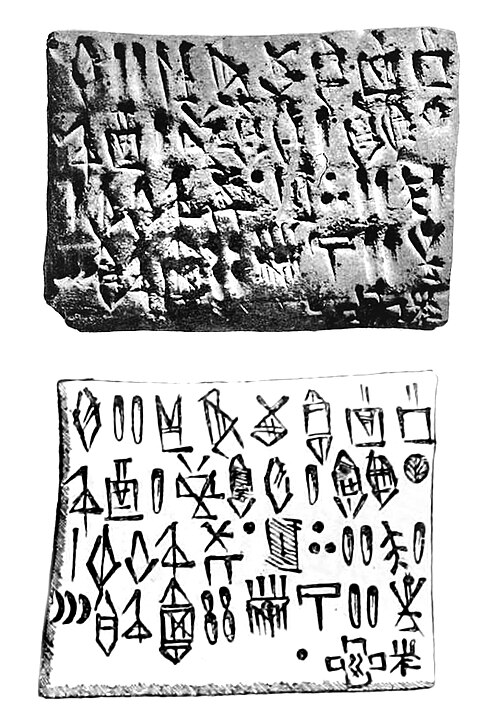
Among the clay tablets recovered at Susa is an account listing of four groups that can be interpreted as small livestock: 22, 9, 18, and 16 animals, followed by a total of 65. Its arithmetic can be understood more confidently than its language. The quantities add up, even though the precise meanings of some accompanying signs remain uncertain. Discussed by Robert Englund in his study of Proto-Elamite decipherment, this modest calculation illustrates a fundamental distinction: understanding what an account does is not necessarily the same as translating what it says (Englund, 2004).1
Proto-Elamite writing was used approximately between 3100 and 2900 BCE, although published chronologies differ. Susa provides the largest surviving collection, with smaller groups from sites including Tepe Sialk, Tall-i Malyan, and Tepe Yahya. These records belong to the changing administrative world explored in the preceding article, in which people developed increasingly formal ways of enumerating resources and recording responsibility. They extend our understanding of early institutions, but do not supply a readable narrative of their origins. The designation “Proto-Elamite” can itself mislead. It is a modern scholarly label, not a name provided by the tablets’ authors, and does not establish that the script recorded an early form of the later Elamite language. Its geographical distribution likewise cannot be treated as the territory of a unified state. What can be identified is a shared tradition of recording, expressed through numerical notation and non-numerical signs whose underlying language remains unknown (Englund, 1998).2
Reading the Accounts, Reconstructing Society
The surviving tablets are overwhelmingly administrative. Rather than preserving connected narratives, they organise entries, quantities, and totals. Headings introduce accounts; repeated combinations distinguish categories; numerical summaries gather separate entries together. Recognising these structures allows researchers to reconstruct an operation without assigning a spoken reading to every sign. A document may therefore be understood as an account of livestock or grain while remaining unreadable as language. Englund’s analyses established numerical notation as one of the strongest routes into this material. Proto-Elamite scribes did not use one universal system equivalent to modern numerals. They employed different conventions for counting objects and measuring quantities. Decimal notation served animals and people in certain contexts, while other systems measured grain capacity or counted different classes of objects. An impression’s numerical value could depend on the system in which it appeared.
 |  |
|---|
Totals provide a means of checking these interpretations. If proposed values make the individual entries reconcile with the final quantity, the account supplies an internal mathematical test. Related documents can then be compared to determine whether the same interpretation works elsewhere. Connections with earlier Mesopotamian numerical practices offer another source of comparison, but they do not provide a dictionary for the entire Proto-Elamite script. Each proposed reading must remain consistent with the tablets themselves (Englund, 1998; 2004). This distinction explains how knowledge can advance without complete decipherment. A researcher might establish that an entry records a quantity of grain without recovering the ancient word for that grain. A recurring sign might distinguish a category of livestock without revealing its pronunciation. Numerical, functional, and linguistic understanding are related achievements, but they are not interchangeable. Translating every uncertain sign into an apparently precise modern term would conceal the uneven quality of the evidence.
Even this partial understanding reveals significant features of social organisation. Grain and animals appear as resources to be enumerated, allocated, and brought within larger accounts. Some documents associate groups interpreted as workers with grain quantities, while longer records organise entries into subdivisions and totals. These arrangements indicate procedures through which administrators classified recipients and combined separate transactions into an institutional record. They do not, however, reveal the complete social relationships behind those procedures. A grain allocation is not automatically a wage in the modern sense, and dependence on an institution does not by itself establish the legal status of slavery. The distinction between household members, institutional dependants, and other workers cannot always be recovered. Englund’s discussion of labour accounts therefore provides evidence for organised allocation rather than a complete description of employment or social rank.
Individuals are similarly difficult to identify. A sign combination in a position where a personal name might be expected need not represent a name written phonetically. It might designate an office, institution, or administrative unit. Jacob Dahl’s methodological reassessment emphasises the importance of examining how such combinations function across documents. A recurring designation can become intelligible as part of an accounting structure without yielding the identity of a particular person (Englund, 2004; Dahl, author manuscript).

The distribution of tablets places these practices within a wider regional setting. Related conventions at Susa and other settlements show that administrative knowledge operated beyond one centre. Yet shared procedures do not identify how that knowledge travelled, nor prove that every participating settlement answered to Susa. The evidence supports connections between communities more securely than a reconstruction of their political boundaries. Proto-Elamite must also be distinguished from Linear Elamite, a later writing system. Their relationship remains disputed. Similar-looking signs may invite comparison, but graphic resemblance alone cannot demonstrate continuity. Their positions, combinations, and functions within texts must also be examined. Dahl challenges arguments that establish a relationship principally through sign shapes; proposed readings of Linear Elamite cannot simply be transferred to the earlier tablets (Englund, 1998; Dahl, author manuscript).
The historical importance of Proto-Elamite does not depend on announcing its complete decipherment. Itsaccountingstructures already reveal communities maintaining records of resources, allocations, and responsibility. They show how quantities could be preserved beyond a spoken exchange and how separate entries could be assembled into larger administrative statements.
At the same time, these documents offer an institutional view of society. People appear as categories, designations, and recipients rather than narrators of their own experiences. The accounts help recover how resources were organised, but rarely how those arrangements were understood by the people recorded within them. Their value lies in this combination of disclosure and silence: they make parts of an early administrative world intelligible while reminding us that understanding its operations is not the same as recovering its language or its inhabitants’ voices.
Footnotes
https://cdli.earth/files-up/publications/englund2004c.pdf
Return to referencehttps://www.iranicaonline.org/articles/elam-iii/
Return to reference
Sources & Further Reading
- Dahl, Jacob L · Proto-Elamite and Linear Elamite, a Misunderstood Relationship
- Englund, Robert K. 1998. · Elam iii. Proto-Elamite.” Encyclopaedia Iranica VIII/3: 325–330
- Englund, Robert K. 2004. · The State of Decipherment of Proto-Elamite.