 Iran Chronicle
Before the Achaemenids: Iranian Languages and Persian Origins
Long before the Persian Empire, Iranian languages became established across a plateau already home to diverse communities. The opening article of Ancient Iran brings together linguistics, archaeology, and ancient DNA to explore what the “arrival of the Iranians” actually means—distinguishing the movement of people from the spread of languages and the emergence of identities.
ACHAEMENID PERSIA · PART 1
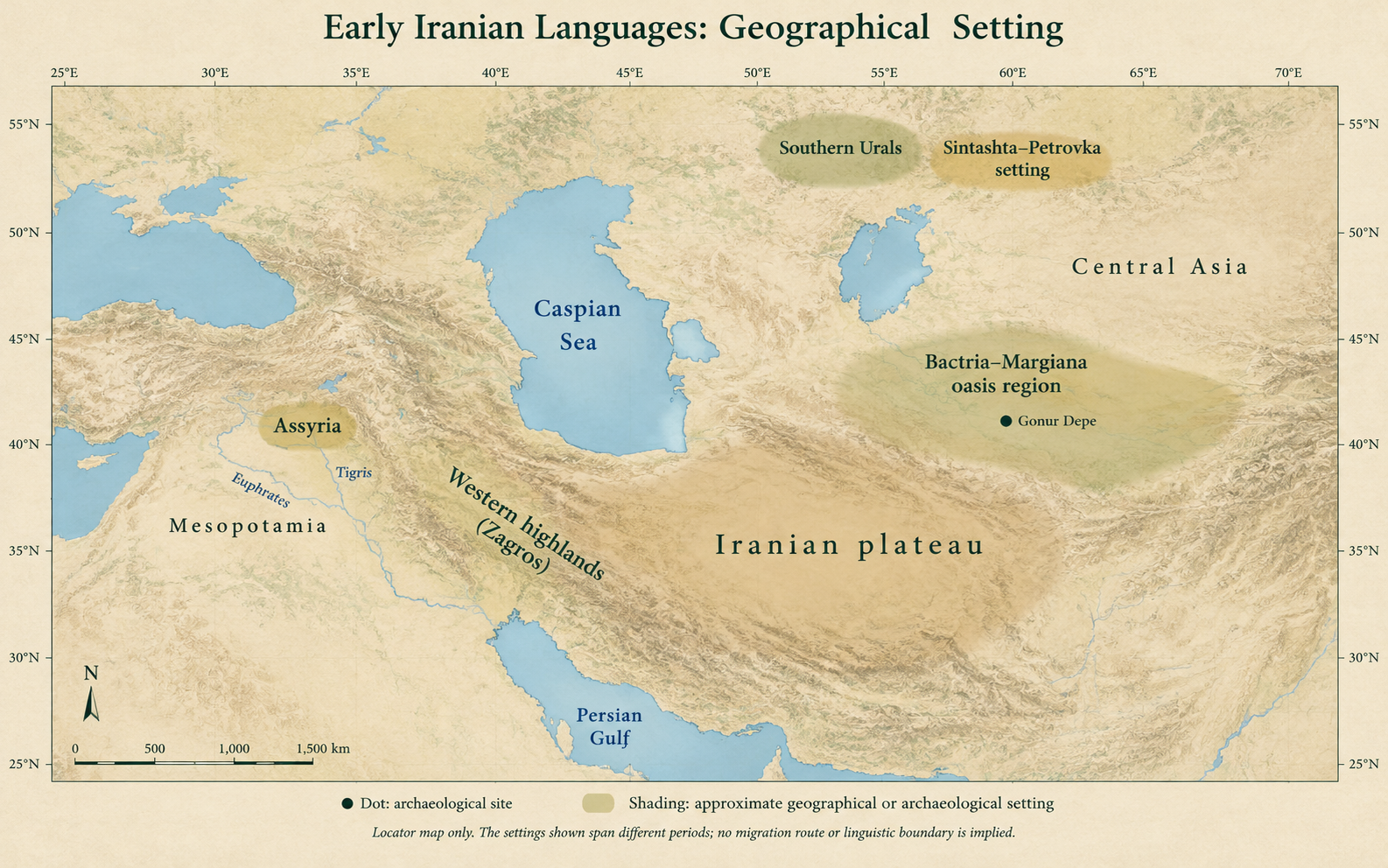
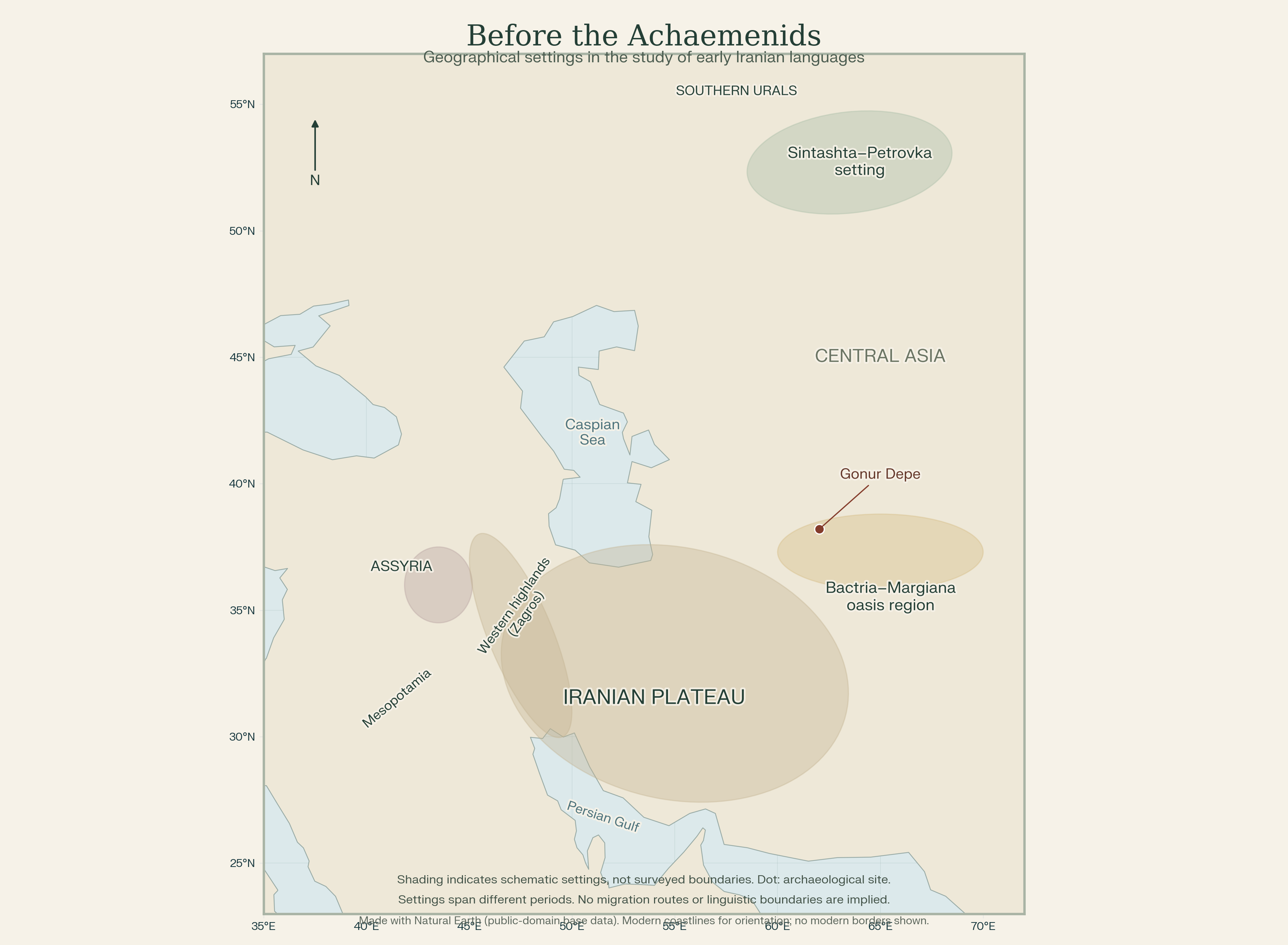
In the account of his twenty-fourth regnal year, the Assyrian king Shalmaneser III described a campaign east of his kingdom. After leaving Namri, he received “the payment of twenty-seven kings of the land Parsua.” He then proceeded towards several other lands, including Media. The inscription records tribute, captured settlements, destruction, and deportation. It does not record the arrival of a new people.1That distinction matters. Names associated with the early Iranian-speaking world enter the surviving historical record through the concerns of an outside ruler: whom he fought, what he took, and where he claimed authority. His account tells us that these communities were visible to Assyria in the ninth century BCE. It does not tell us when they were formed, how long their inhabitants had lived there, or precisely which languages every community spoke.
 |  |
|---|
What, then, do we mean when we say that “the Iranians arrived in Iran”? The question brings together several histories; the movement of people, the spread of languages, and the development of identities. These processes could overlap without being identical. Newcomers might introduce a language that existing inhabitants gradually adopted. Communities might retain much of their ancestry while changing their speech. Different regions could experience different combinations of movement and continuity.
The task is therefore not to choose between migration and an enduring local population. It is to investigate how both contributed to the emergence of Iranian-speaking societies within an already inhabited landscape.
Before Iranian: languages and their wider world
In historical linguistics, “Iranian” identifies a family of related languages descended from a reconstructed ancestor called Proto-Iranian. The term does not refer only to languages spoken within modern Iran, nor does it imply that their speakers shared one biological ancestry. Iranian languages historically extended across a much wider area, including Central Asia and the Eurasian steppe. Iranian belongs within the Indo-Iranian branch of the Indo-European language family. Indo-Aryan belongs within Indo-Iranian too. The Nuristani languages constitute another recognised subgroup, although their precise historical relationship to Iranian and Indo-Aryan remains debated. This family relationship describes linguistic descent, not a succession of nations or a sequence of biologically distinct populations. The ancestral languages are reconstructed rather than preserved in contemporary documents. Linguists compare recurring patterns in vocabulary, sounds, and grammar. An isolated resemblance between words may result from borrowing or coincidence; a consistent set of correspondences across many words and grammatical forms provides stronger evidence of common descent.
The oldest Indic and Iranian traditions are especially important. Comparison between the language of the Rigveda and Old Avestan, preserved within the Iranian religious tradition, helps reconstruct their Indo-Iranian background. Neither language is simply the parent of the other. They preserve related developments from an earlier linguistic world2. Vocabulary can also connect linguistic reconstruction with material history. In a specialist study published in 2023, Alexander Lubotsky examined shared Indo-Aryan and Iranian terms for chariots, charioteers, and chariot fighters. These suggest that the ancestral linguistic community knew chariot warfare. He relates that vocabulary to the early chariots documented in the Sintashta–Petrovka archaeological setting of the southern Trans-Urals, around the beginning of the second millennium BCE3.
 |  |
|---|
This is a substantive argument, not merely a resemblance between words and objects. It combines reconstructed terminology with the archaeological history of a technology. Nevertheless, its chronological conclusions remain scholarly interpretations. Lubotsky’s proposed dating of the separation of Indo-Iranian should not become an unquestioned date for the appearance of Iranian speakers on the plateau.
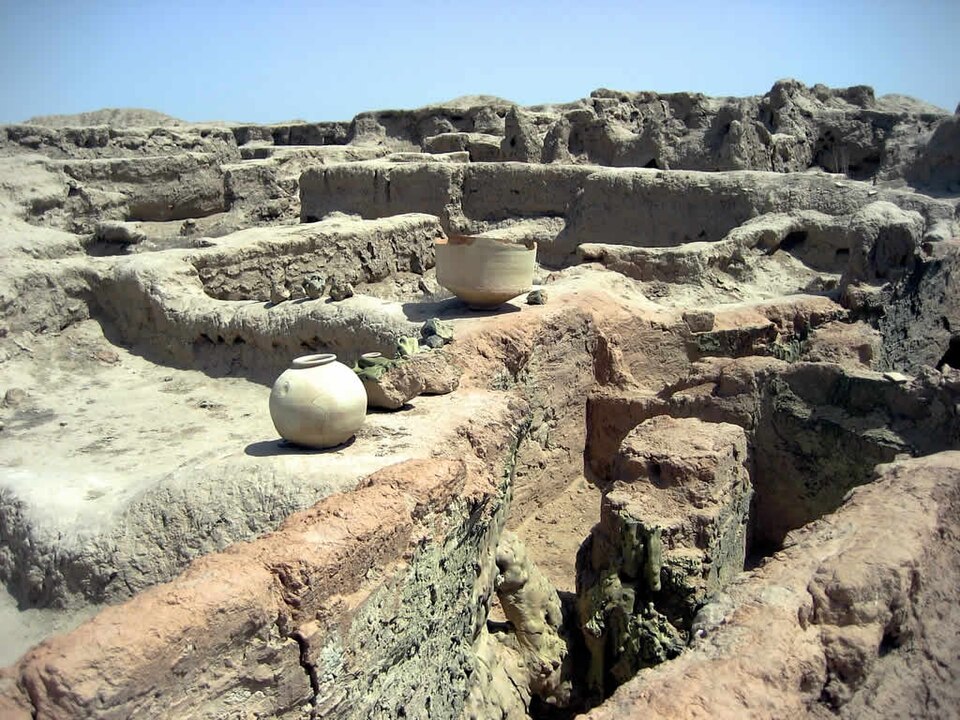
Sintashta–Petrovka and the wider Andronovo archaeological horizon are consequently important to the discussion, but their names require explanation. They are modern classifications based on material remains, not ethnic designations written by their inhabitants. Lubotsky describes growing agreement over a Proto-Indo-Iranian association for Sintashta–Petrovka. Extending that association to particular later movements, languages, and communities requires further argument. The steppe was not the whole setting. Farther south, the oasis settlements of the Bactria–Margiana Archaeological Complex, often called BMAC or the Oxus civilisation, formed another world of settlement, production, and exchange. Its relationships with northern communities matter because language histories developed through contact, not simply through separation.
Lubotsky proposes that shared loanwords in Indo-Aryan and Iranian reflect sustained interaction with an urban society, identifying BMAC as the most plausible source. His argument connects vocabulary concerning built environments and cultural practices with contact between northern pastoral communities and southern oasis populations. The interpretation is significant, but it does not identify the language of every BMAC settlement or establish a single route followed by all later Iranian speakers. The plateau must remain central to this account. Its inhabitants had histories extending far beyond these proposed movements. The communities explored in "Before Cyrus series" occupied established settlements, developed regional institutions, and participated in long-distance exchange. They were not passive recipients of change from the north.
Genetic research reinforces the depth of connections between the Iranian plateau and southern Central Asia. Populations in these regions shared ancestry relationships long before the Achaemenid Empire. The North-Eastern approaches to the plateau were therefore not a boundary between two sealed populations. They formed part of a connected landscape in which movement could occur in several directions.
This helps explain why an arrow labelled “Iranian migration” can conceal more than it reveals. A map may show a proposed direction, but not the duration of contact, the variety of communities involved, or the social circumstances in which languages spread.
Three kinds of evidence, different historical questions
Archaeology reconstructs much of this world through settlements, burials, tools, vessels, and production. It can demonstrate changing connections and practices. It is less able, without texts, to identify the language spoken by the people responsible.
Grey pottery illustrates the difficulty. Its appearance and distribution have often entered discussions of Iranian migrations and the Medes. Yet a ceramic tradition cannot simply be treated as a linguistic identity. Iranica’s assessment of Median archaeology questions the identification of grey pottery as specifically Median, including problems of chronology and geographical distribution. Objects may travel through exchange. Techniques may spread through imitation. People may adopt unfamiliar styles without changing language, while related language communities may use different pottery. Migration becomes a stronger explanation when several independent observations converge, but even convincing evidence for newcomers does not automatically identify their speech.
Ancient DNA adds another kind of evidence. It can reveal biological relationships, ancestry affinities, and population mixture. These findings can test demographic interpretations that archaeology alone leaves uncertain. But an ancestry component is not a language or an ancient tribe. The reference populations used in genetic models are tools for comparison, not necessarily the exact historical communities involved in a migration. A major study by Vagheesh Narasimhan and colleagues, published in Science in 2019, generated genome-wide data from 523 previously unsampled ancient individuals, principally from Central Asia and northernmost South Asia. It examined relationships among steppe populations, oasis communities, and populations connected with the Iranian plateau and South Asia. The principal sampled BMAC population lacked the steppe pastoralist ancestry investigated in the study. However, individuals carrying such ancestry appeared at BMAC-associated sites approximately between 2100 and 1700 BCE. The findings show that communities with different ancestry histories were interacting within the same broader archaeological world. They also document movements and mixture extending towards South Asia.4

These results matter because they establish human mobility rather than merely the circulation of objects. They support a wider setting in which movements of people could have contributed to language dispersal. But the study’s geographical emphasis imposes a limit: evidence for Central Asian and South Asian population history does not by itself reconstruct how Iranian languages became established throughout Iran.
A second study brings the plateau more directly into view. In 2025, Motahareh Ala Amjadi and colleagues published an investigation emphasising long-term ancestry continuity in northern Iran. After analysing 50 samples from nine sites, they reported 23 newly sequenced mitochondrial genomes and 13 nuclear genomes. These numbers represent different datasets, not 50 complete genomes. Mitochondrial DNA follows a maternal line of descent; nuclear DNA provides a broader ancestry record. The historical northern Iranian individuals showed strong relationships with earlier populations of North-Eastern Iran and southern Central Asia. The authors interpreted their ancestry partly through an enduring east–west geographical gradient, rather than a single recent replacement event. Their results underline the continuing contribution of populations already established in the region.5
The study’s title refers to thousands of years of continuity, but that must not be read as proof that every community remained unchanged. The newly analysed historical material focuses particularly on northern sites from the Achaemenid to Sasanian periods, much later than many proposed language movements. The main article also identifies limited genome-wide samples and acknowledges gaps in regional coverage. Its findings cannot establish an identical population history for the whole plateau.
The two studies need not be competing explanations. One documents movements across Central Asia and into South Asia; the other emphasises enduring ancestry relationships in sampled Iranian populations. Migration does not require wholesale replacement. Continuing local ancestry does not exclude newcomers, intermarriage, or the adoption of a new language. Equally, genetic continuity cannot demonstrate that Iranian languages had been spoken on the plateau since the Neolithic. Biological descent and linguistic descent answer different questions. A population’s descendants may preserve much of its ancestry while speaking a language acquired through later contact. The strongest historical reconstruction therefore depends on convergence. Linguistics identifies relationships among languages and sometimes traces contact through borrowing. Archaeology reconstructs the settings in which people lived and interacted. Genetics investigates biological connections and demographic change. Agreement among them can strengthen an explanation, but none should be made to fill another’s evidential gaps automatically.
The exact routes and chronology by which Iranian languages spread across the plateau consequently remain unresolved. Northern and North-Eastern connections are important, but no single securely established itinerary links every proposed ancestral community to the later Medes and Persians. Different regions may have experienced different histories.
Returning to Shalmaneser’s inscription, we can now see both its value and its limits. The passage places Parsua and Media separately within a campaign account. Its twenty-seven kings belong to Parsua: they should not be transformed into twenty-seven Median rulers or evidence for a unified Iranian state. The inscription records a landscape of multiple authorities encountered by an expansionist king.6The relationship between Parsua and the later Persians also needs restraint. Scholars have connected the earlier name linguistically with Old Persian Pārsa, but linguistic resemblance does not by itself establish that one identifiable community moved from the Assyrian campaign region to Fars. Iranica’s linguistic survey explicitly qualifies the identification of the early group.
By the ninth century BCE, written sources begin to illuminate communities associated with the early Iranian-speaking world. Yet this historical visibility comes after much of the language history we are trying to reconstruct. The texts provide points of reference, not a complete account of origins.
The emergence of Iranian-speaking societies is best understood through interaction; movements of people, enduring local communities, and changing languages and identities. None of these needs to erase the others. The next article turns to a more specific transformation how Persian communities in southwestern Iran became connected with Anshan, and how that setting helped shape a royal house whose ambitions would eventually reach far beyond the plateau.
Footnotes
https://oracc.museum.upenn.edu/riao/Q004619
Return to referencehttps://www.iranicaonline.org/articles/iran-vi5-indo-iranian/
Return to referencehttps://scholarlypublications.universiteitleiden.nl/access/item:3754407/view
Return to referencehttps://pmc.ncbi.nlm.nih.gov/articles/PMC6822619/
Return to referencehttps://www.nature.com/articles/s41598-025-99743-w
Return to referencehttps://oracc.museum.upenn.edu/riao/Q004619
Return to reference
Sources & Further Reading
- Iran vi. Iranian Languages and Scripts · Encyclopaedia Iranica Source
Continue this collection
Achaemenid Empire — Article 1 of 6