 Iran Chronicle
Iran’s Cultural Legacy: From Ancient Persia to the End of the Pahlavi Era - Part 1
Laurens R. Krol
Iran’s cultural history is a story of inheritance repeatedly remade. Across changing empires, religious transformations, and shifting borders, people preserved languages, retold stories, built institutions, and found new uses for established forms. What endured did so through human effort—not because history left it untouched.
An Inheritance Made and Remade
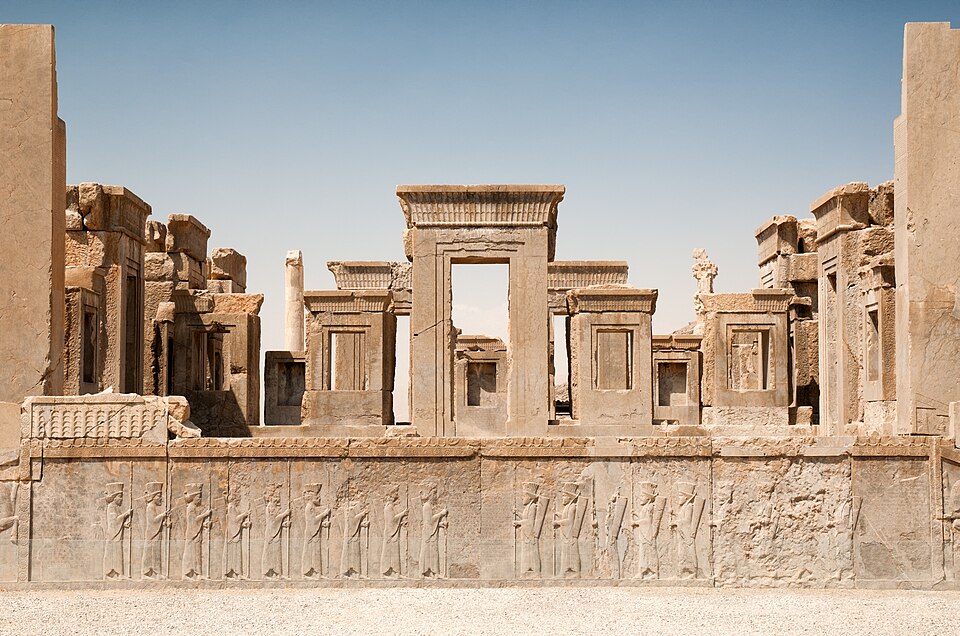
At Persepolis, carved delegations approach the royal presence in orderly procession. Their clothing, headgear, animals, and vessels distinguish one group from another. Difference has not disappeared. It has been arranged around the authority of the king. The Achaemenid court represented its empire as a world whose many peoples participated in a stable political order. More than two thousand years later, modern Iranian artists found material for their work in devotional objects, calligraphy, mirror mosaics, locks, bowls, and the earth and straw of vernacular buildings. Their sources included the everyday as well as the monumental. What connected them with the past was not the reproduction of an established style but the possibility of making inherited materials speak differently. The distance between an imperial relief and a modern artwork is immense, yet both belong to a history in which cultural forms acquired meaning through the circumstances of their production and use.1
That history cannot be contained within a sequence of dynasties, although changes of government profoundly affected it. Courts supported poets, painters, musicians, and scholars; conquest destroyed communities and displaced expertise; religious institutions provided settings for learning, performance, and patronage. Households, workshops, merchants, teachers, and audiences sustained practices that rulers neither invented nor fully controlled. Nor does the cultural history of Iran fit neatly within the borders of the modern state. Bukhara, Samarkand, Herat, Baghdad, and Konya enter the story because they were important centres in their own right. Persian literary culture developed through communities across Central Asia, Afghanistan, Anatolia, and the Indian subcontinent. Within Iran, Persian coexisted with other languages and traditions rather than exhausting the country’s cultural life.
The central question is therefore not whether Iran possessed an unchanging essence. It is howinheritanceworked: what people transmitted, what they altered, what they abandoned, and what they were prevented from preserving. An epic could survive while acquiring new illustrations and political meanings. A religious observance could develop a new theatrical form. A language could change its script and vocabulary while retaining connections with earlier speech. Continuity and transformation were not opposites. Frequently, transformation was the means by which something continued.
Achaemenid Persia: Empire, Images, and Cultural Plurality
The Achaemenid Empire emerged in the sixth century BCE through the conquests of Cyrus II and his successors. At its greatest extent, it encompassed territories stretching from Egypt and Anatolia across western Asia to Central Asia and the north-western Indian subcontinent. It brought established societies under a new imperial authority, incorporating communities with their own languages, religious practices, artistic skills, and political memories. Such an empire required more than military success. Its rulers needed ways to administer territory, communicate authority, and make a diverse political world appear coherent. Architecture, inscriptions, ceremonial settings, and portable objects supplied different answers. They did not eliminate regional distinctions; they placed those distinctions within an imperial framework.
AtPersepolis, developed under Darius I and his successors, that framework became monumental. Columned halls, terraces, stairways, and reliefs organised both space and movement. The delegations carved on the Apadana stairways approach with vessels, textiles, animals, and other offerings. Their differences are carefully rendered, but the scene is governed by composure. The court presents diversity as orderly participation in kingship.
 |  |
|---|
The imagery is striking partly because it differs from representations dominated by the violent humiliation of defeated enemies. Yet its calm should not be mistaken for evidence that imperial rule was universally harmonious. The same monarchy expanded through conquest and suppressed rebellion. Persepolis shows how the court wanted its authority understood, not how every subject experienced it. Its beauty and its political purpose belong to the same object. The art also embodied the empire’s interconnected character. Achaemenid production drew on practices associated with several older cultural centres. Forms, techniques, and materials were selected and recombined under royal patronage. The result was neither a collection of unrelated borrowings nor an expression created in isolation. Imperial art made the contributions of different regions serve a recognisable courtly language.
Its makers become more visible when we turn from palace reliefs to administrative records. The Persepolis archives preserve clay tablets and sealings produced by agencies responsible for the royal economy. Treasury documents record distributions of silver and foodstuffs to workers in Persepolis and its surroundings. They identify people associated with regions including Egypt, Babylonia, Lydia, Ionia, Bactria, and Sogdiana. These documents change the scale of the story. The palace presents an accomplished expression of command; the accounts disclose some of the arrangements that sustained it. Materials had to be gathered, workers organised, and resources distributed. Cultural achievement depended on administrative routines as well as exceptional design.
The Fortification Tablets are also important evidence for women’s economic activity and the position of royal women. They complicate the predominantly male world of royal representation. Their significance lies not in proving modern equality but in making forms of participation visible that monumental imagery alone would leave obscure.2Portable luxury objects operated in more intimate settings. Finely worked bowls, ornaments, and animal-shaped vessels combined expensive materials with technical accomplishment. Their social value lay not simply in their gold or silver but in the expertise required to transform those materials. A vessel could distinguish its owner, enrich a ceremonial occasion, or circulate through elite exchange.
Religion introduces a different interpretive problem. Achaemenid royal inscriptions give Ahura Mazda an important place, but the precise relationship between royal devotion and the teachings associated with Zoroaster remains debated. Later Zoroastrian texts cannot simply be projected backwards to reconstruct the complete religious life of the empire. Its territories contained multiple communities and practices, and royal statements do not provide a census of belief. Similarly, accommodation should not be confused with equality. Allowing established institutions to function could be an effective instrument of government without removing the inequalities inherent in imperial rule. The Achaemenids need neither to be celebrated as the founders of modern liberal values nor reduced to the hostile image of eastern despotism inherited from some Greek narratives.
Alexander’s campaigns ended Achaemenid power in the fourth century BCE. Political defeat, however, did not empty the former empire of skills, local institutions, or cultural memory. The world that followed was not a blank interval before the return of another Iranian dynasty. It was a new setting in which people worked with a changing range of possibilities.
After Alexander: Hellenistic Encounters and the Parthian World
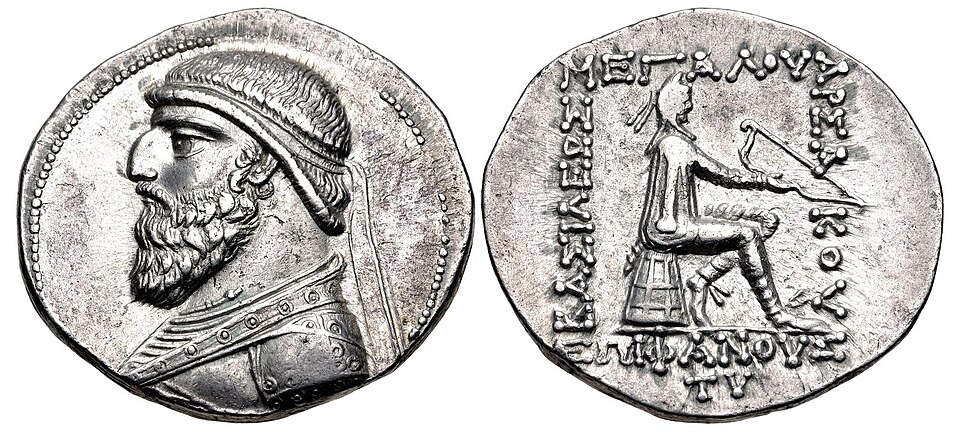
Alexander’s conquests and the rule of his successors introduced Greek and Macedonian political institutions and artistic forms into territories long governed by the Achaemenids. Their presence altered the cultural landscape, but it did not produce a uniformly Greek society. Regional traditions continued, while new patrons and communities selected from the forms available to them. The Arsacid dynasty, conventionally associated with the Parthian Empire from 247 BCE to 224 CE, governed an extensive and heterogeneous world. Its remains include sculpture, jewellery, architectural decoration, drinking vessels, and coins. These objects reveal choices that resist a simple division between foreign influence and indigenous survival.
A drinking horn could combine animal imagery with decoration associated with Dionysian traditions. Architectural ornament could place ancient Near Eastern creatures beside forms connected with the Mediterranean world. Such combinations need not have seemed contradictory to their makers. A motif did not carry one permanent meaning wherever it travelled. Its significance could change with its material, setting, patron, or audience. The surviving record is geographically uneven. Hatra, an important centre associated with the Parthian world, lay in present-day Iraq. Other remains come from regional or frontier settings, while evidence from major centres has been lost through destruction and later settlement. What survives therefore reflects the circumstances of preservation and excavation as much as the original distribution of cultural activity.
 |  |  |
|---|
Coins offer another perspective. They circulated royal images beyond monumental environments and could associate rulers with established forms of authority. Yet even this apparently direct evidence presents difficulties. The repeated use of the dynastic name Arsaces complicates the assignment of some issues to individual kings. Small objects can carry abundant information without making interpretation simple. The Parthian centuries also matter for the history of performance. Thegosan, a minstrel associated with feasts, ceremonies, heroic tales, and lyrical poetry, belonged to a world in which memory was sustained through repeated telling. Scholarship has connected this background with material preserved or reworked in later Persian literature.
The importance of those connections is not that we possess an unbroken transcript from ancient performance to medieval text. We do not. It is that oral transmission provides a plausible setting in which stories, characters, and narrative structures could endure while their wording changed.
A performer might preserve the recognisable outlines of a hero’s story while adapting its emphasis for a new audience. A narrative could move between languages or acquire new ethical and political associations. What endured was not necessarily a fixed text but a body of material that people continued to find worth performing. The study of thegosantherefore helps explain how an inheritance can remain influential without surviving in its earliest form.3
This makes the Parthian period central rather than transitional. Its cultural life was not merely a bridge between Achaemenid and Sasanian greatness. It demonstrates that the traditions later understood as Iranian had already developed through interaction, selection, and movement. Their history did not begin with purity and become mixed only through later conquest. The Parthian world also establishes a recurring difficulty for cultural history: written evidence is not a reliable measure of the quantity or richness of cultural life. Performance, craftsmanship, and local practice can leave fewer recoverable traces than royal inscriptions. The historian must acknowledge that imbalance without filling every gap with claims of timeless continuity.
The Sasanians: Sacred Kingship and a Far-Travelling Art
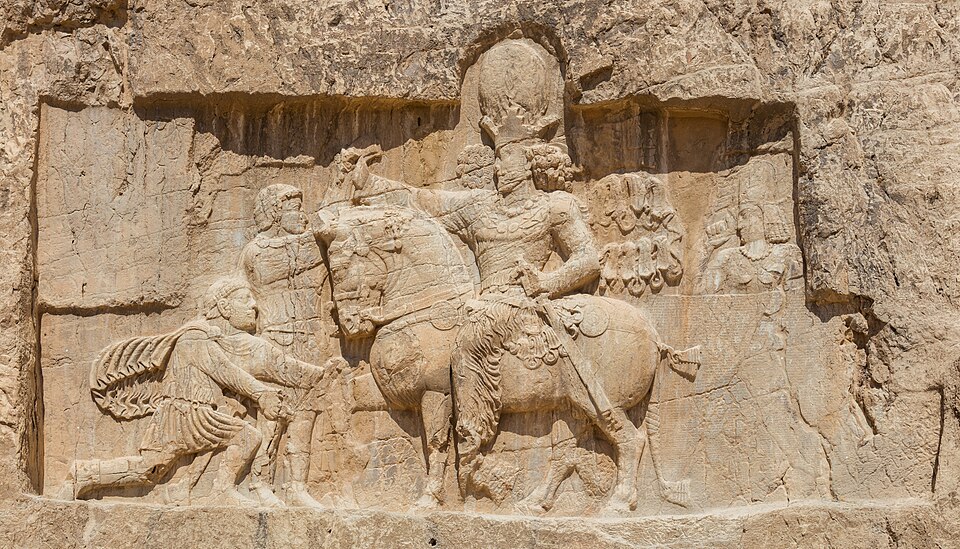
Around 224 CE, Ardashir I defeated the Parthians and established the Sasanian dynasty. For more than four centuries, Sasanian rulers governed a major empire whose centres extended beyond present-day Iran. Ctesiphon, on the Tigris near modern Baghdad, belonged to this world as fully as the royal monuments of Fars. Sasanian kingship made forceful use of images. At Naqsh-e Rostam, Ardashir appears receiving a ring of authority from Ahura Mazda. Investiture scenes connected political sovereignty with sacred order; victory reliefs presented the ruler’s triumphs as events worthy of permanent commemoration. Their placement in the landscape gave royal claims a durable public presence.
The royal hunt supplied a related language. On silver vessels, kings confront dangerous animals with controlled strength. The scene is more than an account of recreation. It represents an ideal ruler mastering forces that might otherwise threaten order. Crown forms, compared with those on coins, can sometimes help identify the royal figure. Such vessels made the representation of kingship portable. Unlike a cliff relief, a silver plate could enter an elite household, ceremonial exchange, or diplomatic setting. The imagery travelled with the object, detached from the immediate presence of the ruler but still associated with the prestige of his court.
 |  |
|---|
Sasanian craftsmanship was neither isolated nor static. It adapted Greco-Roman and ancient Near Eastern forms, including motifs connected with Dionysian imagery. Trade, diplomacy, warfare, and the movement of craftspeople helped carry objects and designs across great distances. Sasanian visual traditions left traces in Central Asia, China, and early medieval Europe. Their influence did not imply political sovereignty over every place where an adapted form appeared.4The movement of a design is also different from the movement of an object. A vessel might travel intact, but a pattern could be copied into another medium by a workshop that had never encountered its original use. Local makers selected what suited their materials and customers. Influence therefore involved reinterpretation rather than the simple extension of a finished artistic system.
Religion was central to Sasanian institutions, but the empire’s religious life cannot be reduced to a uniform experience. Zoroastrian authorities acquired considerable importance, while relations between monarchy, priesthood, doctrine, and practice changed over time. Other religious communities remained part of the imperial world. A statement of royal religious policy should not be taken to describe every household’s beliefs. Intellectual activity likewise crossed boundaries. Syriac-speaking scholars and Christian medical networks participated in the transmission of learning that later contributed to Arabic-language scholarship. The familiar image of knowledge passing directly from Greece into a single Persian institution is too simple. Translation involved intermediaries, different languages, and successive reinterpretations.
Stories about ancient centres of learning require particular caution because later accounts can give them a more fully developed institutional form than contemporary evidence supports. The substantial achievement is not diminished by distinguishing what is securely documented from what belongs to retrospective prestige. Music occupied an important place in Sasanian courtly memory. Barbad, associated with Khosrow II, became a major figure in later accounts of Persian musical history. Artistic representations of instruments and musicians help establish the importance of performance, while literary traditions preserve names and stories. They do not give us a complete archive of ancient sound.
It would therefore be misleading to identify a modern repertoire as unchanged Sasanian music. Continuity might operate through terminology, remembered authorities, stories, or selected musical practices without preserving a performance intact. Music’s dependence on listening and teaching makes it especially vulnerable to the difference between what people practised and what later sources can recover. The dynasty ended amid warfare, internal instability, and the Arab conquests. Yazdgerd III, its last ruler, died in 651. The extinction of the royal house did not instantly remove the languages, habits, and knowledge of its former subjects.
Footnotes
https://www.metmuseum.org/essays/the-achaemenid-persian-empire-550-330-b-c
Return to referencehttps://www.iranicaonline.org/articles/persepolis-admin-archive/
Return to referencehttps://iranicaonline.org/articles/gosan/
Return to referencehttps://www.metmuseum.org/essays/the-sasanian-empire-224-651-a-d
Return to reference
Sources & Further Reading
- Ashraf, Ahmad · Iranian Identity i. Perspectives.” Encyclopaedia Iranica A discussion of competing approaches to the historical relationship between Iranian cultural identity and modern nationalism.
- The Metropolitan Museum of Art · The Achaemenid Persian Empire (550–330 B.C.) eilbrunn Timeline of Art History. October 2004. The principal museum synthesis used for imperial geography, royal representation, and the interpretation of Persepolis.
- Encyclopaedia Iranica · Gōsān On minstrelsy, oral performance, and the relationship between Parthian traditions and later Iranian literature