 Iran Chronicle
From Hunting to Herding: The Goats of Ganj Dareh
Masdf98
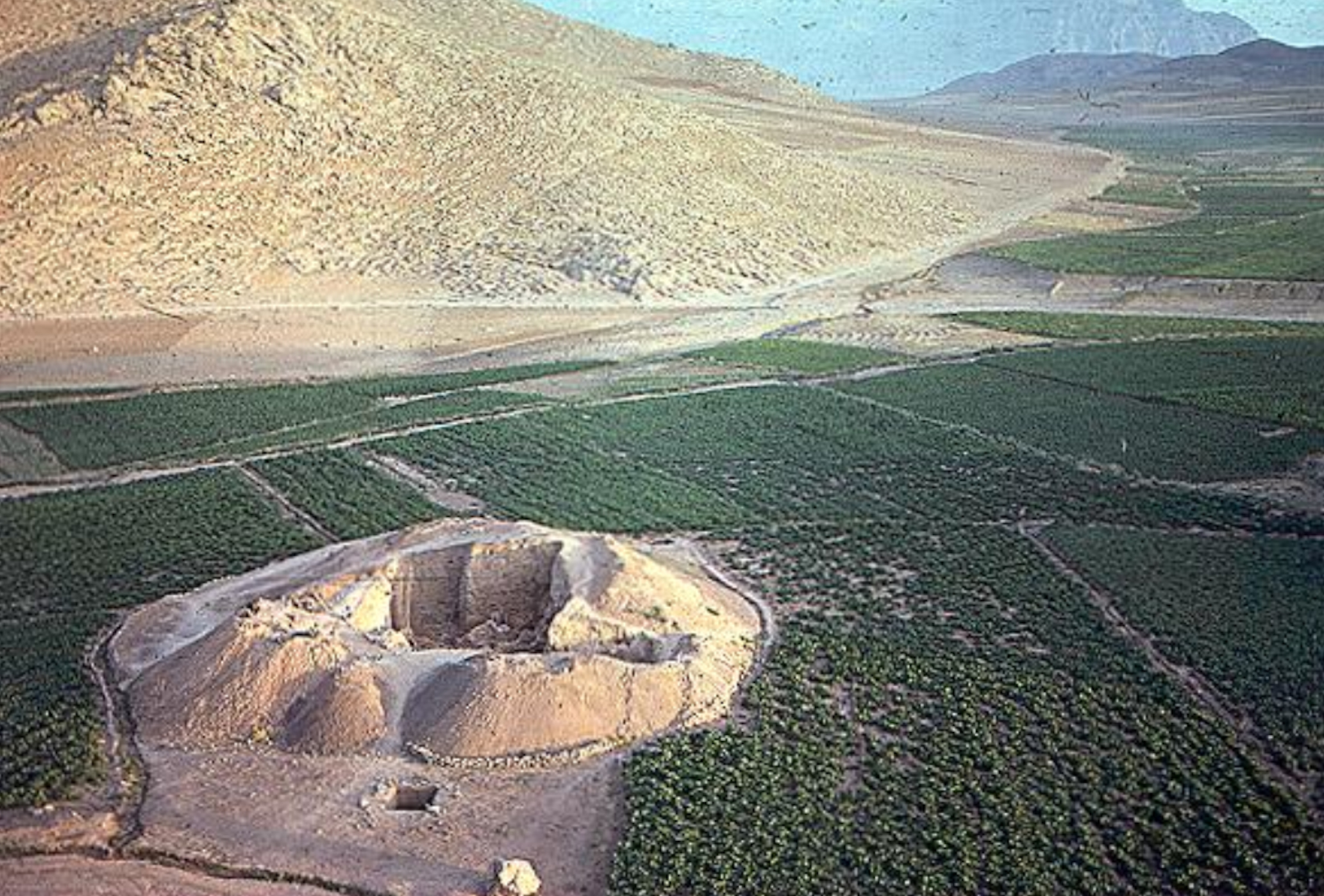
The early Neolithic settlement of Ganj Dareh, near Harsin in the central Zagros Mountains of western Iran, preserves some of the earliest clear evidence for the management of goats.
By approximately 8200 BCE, its inhabitants were maintaining animals whose bodies still resembled those of wild goats but whose patterns of survival and reproduction had been altered by human intervention. Animal-bone studies and ancient DNA together reveal a relationship that cannot be described adequately as either hunting wild animals or keeping livestock in the fully developed sense familiar from later farming societies. Ganj Dareh is important precisely because it illuminates the process between these conditions (Daly et al., 2021).1
|  | 
|
The settlement stood approximately 1,400 metres above sea level in a region where wild goats formed part of the available animal resources. Excavations revealed mud-brick buildings, plastered surfaces, hearths, and spaces interpreted as storage areas, alongside grinding equipment, plant remains, stone tools, and clay objects. Goat management therefore belonged to a broader settlement economy rather than an isolated activity. Nevertheless, the relationship between food production and settled life was not straightforward. Reassessment of the excavation records has shown that Ganj Dareh’s architectural and occupational history was more complicated than its traditional division into five principal levels might suggest. It should not be treated as a simple demonstration that herding immediately produced permanent village life (Riel-Salvatore, Lythe, and Uribe Albornoz, 2021).2
For the hunter-gatherers discussed in the preceding article, obtaining animal food depended substantially on encounters with wild populations. At Ganj Dareh, the evidence indicates a different relationship: people maintained access to living goats and influenced which animals survived to reproduce. Recognising that change, however, requires more than identifying goat bones in a settlement. Hunters also killed goats, while the earliest managed animals did not necessarily possess smaller bodies or other obvious anatomical characteristics associated with later domestic populations. The distinction became clearer through research that considered age and sex together. Male goats are naturally larger than females, so a collection containing many females may appear smaller without demonstrating an evolutionary reduction in body size. Zeder and Hesse’s influential study challenged reliance on size alone and identified selective slaughter as a more revealing sign of early management. The crucial question was not simply how large the animals were, but which animals people killed and which they allowed to live (Zeder and Hesse, 2000).3
At Ganj Dareh, approximately 60–70% of male goats were killed before reaching two and a half years, whereas approximately 60–70% of females survived beyond that age. This recurring imbalance is consistent with preserving a reproducing herd. Relatively few males are required for breeding, while retaining more females sustains the production of offspring. Slaughtering younger males can consequently provide food without removing the same proportion of the herd’s future reproductive capacity. Comparison with the earlier Zagros site of Asiab strengthens this interpretation: there, an emphasis on older animals and adult males has been understood as hunting directed towards substantial meat returns, rather than the maintenance of a breeding population (Daly et al., 2021). These patterns bring the practical significance of management into view. Killing an animal supplied food immediately; keeping a breeding female alive preserved the possibility of future animals. The bones do not reveal how inhabitants explained their decisions, but they show a repeated outcome consistent with balancing consumption against reproduction. Herd management thus involved a continuing relationship with living animals, rather than simply a new method of obtaining carcasses. It made the composition and survival of an animal population part of the community’s longer-term food economy.
DNA Research
Ancient DNA provides an additional, partly independent perspective. A study of goat remains from Ganj Dareh and nearby Tepe Abdul Hosein found that most sampled animals belonged to a genetic group with stronger affinities to later domestic goats, while a minority showed closer relationships to wild populations. The researchers interpreted this combination as evidence that hunting continued alongside herding, although interbreeding between managed and wild animals offers another explanation for some specimens. Management did not necessarily create an immediate or impermeable boundary between the two populations (Daly et al., 2021). The same investigation identified substantial diversity in maternal lineages but much more restricted paternal diversity. This accords with the slaughter profiles: numerous females contributed to subsequent generations, while comparatively few males reproduced. The importance of the genetic evidence lies not in replacing the animal-bone analysis, but in supporting it through a different line of inquiry. Age-at-death patterns reveal selective survival; inherited variation helps reconstruct its reproductive consequences.
Other finds place living goats close to settlement life. Hoofprints impressed in mud bricks and remains of newborn or near-birth animals support the presence of breeding animals around the community. Their significance should not be exaggerated: they do not establish a particular arrangement of pens or prove that goats routinely occupied domestic rooms. Likewise, the evidence examined here does not demonstrate a dairy economy, identify who undertook herding, or reconstruct a seasonal grazing route. Such activities are relevant questions, but they cannot be supplied as details of daily life merely because later pastoral communities practised them (Daly et al., 2021).
Ganj Dareh also exposes the difficulty of treating domestication as a single event. Its goats retained skeletal and horn characteristics resembling those of wild bezoar goats even while demographic and genetic evidence indicates management. Human influence over survival and reproduction therefore preceded some of the anatomical changes traditionally used to recognise domestic animals. Calling these goats simply wild overlooks the altered relationship; equating them with later livestock compresses a longer transformation. Nor does the site establish where management first began: the practices visible there were already developed, and their earlier history remains unresolved.
Ganj Dareh’s importance rests less on a claim to absolute priority than on the convergence of its evidence. Selective slaughter, reproductive patterns, and traces of close human–animal contact together reveal communities maintaining goats as a continuing resource. Hunting persisted, and connections with wild populations remained. The transition was neither a clean break nor an inevitable step towards later agriculture, but a developing relationship in which keeping animals alive became as consequential as killing them.
Footnotes
https://www.pnas.org/doi/10.1073/pnas.2100901118
Return to referencehttps://pmc.ncbi.nlm.nih.gov/articles/PMC8372917/
Return to referencehttps://www.science.org/doi/10.1126/science.287.5461.2254
Return to reference
Sources & Further Reading
- Daly, Kevin G. · Herded and Hunted Goat Genomes from the Dawn of Domestication in the Zagros Mountains. Proceedings of the National Academy of Sciences 118: e2100901118. DOI: 10.1073/pnas.2100901118.
- Riel-Salvatore, Julien, Abigail Lythe, and Ariane Uribe Albornoz. · New Insights into the Spatial Organization, Stratigraphy and Human Occupations of the Aceramic Neolithic at Ganj Dareh, Iran. PLOS ONE 16: e0251318. DOI: 10.1371/journal.pone.0251318
- Zeder, Melinda A., and Brian Hesse · The Initial Domestication of Goats (Capra hircus) in the Zagros Mountains 10,000 Years Ago. Science 287: 2254–2257. DOI: 10.1126/science.287.5461.2254