 Iran Chronicle
Beyond the First Villages: Craft, Exchange, and Changing Communities
Ljuba brank at Slovenian Wikipedia
Between the later sixth and fifth millennia BCE, communities on the Iranian plateau developed increasingly demanding ways of making pottery and working copper. These changes did not replace village life with cities, nor did they unfold uniformly across the region.
At Tepe Sialk near Kashan, Tepe Pardis on the Tehran–Varamin Plain, and Tal-i Iblis in southe-astern Iran, archaeological evidence reveals different combinations of technical knowledge, investment in production, and connections between crafts. Their significance lies not simply in the appearance of new objects, but in the choices and relationships that made those objects possible. The early villages discussed in the preceding article had already created enduring settings for food processing, construction, and other recurring work. Later communities extended these practices through more controlled treatment of raw materials and heat. Archaeologists often describe this broad period as Chalcolithic, or Copper Age, although the term should not imply that copper immediately displaced stone. It identifies a period in which metalworking became part of an economy that continued to depend on other materials and skills (Helwing, 2021).1Pottery provides a particularly detailed record of these developments. Its colour and decoration are immediately visible, but the selection of clay, preparation of the ceramic body, and conditions of firing can reveal changes that painted designs alone conceal.
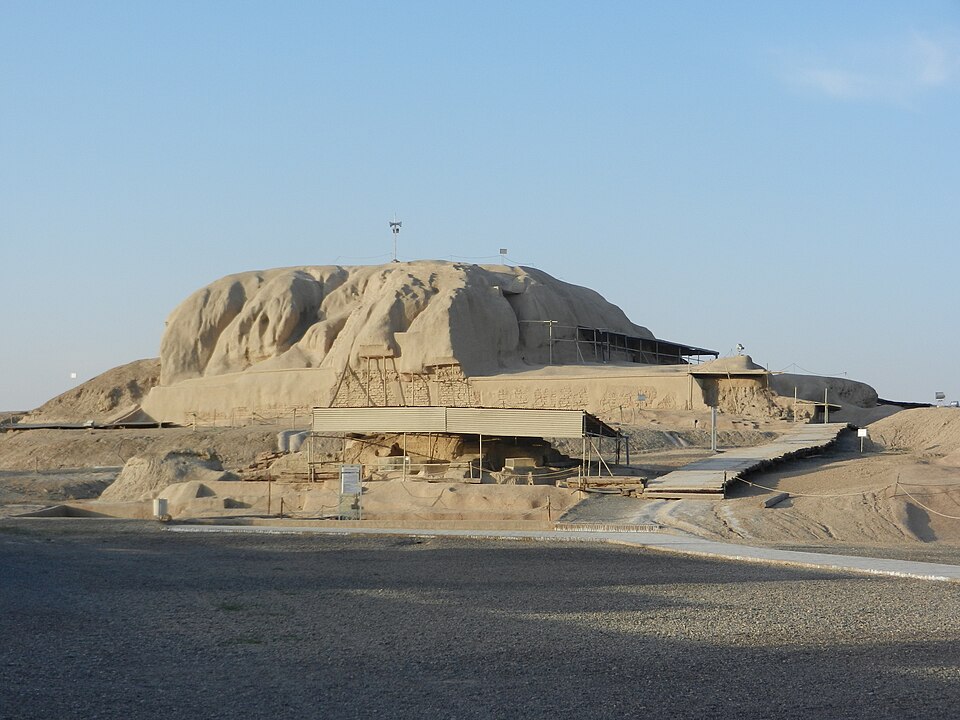
Sialk
Scientific analysis distinguishes different ways of producing red pottery. Some vessels acquired their appearance through a surface coating, while others involved different raw materials and firing conditions. A similar colour could therefore result from different technical decisions. Conversely, a change in appearance did not necessarily mean that an entirely new manufacturing tradition had replaced an older one. This matters because early archaeological interpretations often used pottery styles to identify distinct populations. Changes in colour or decoration could become evidence for the arrival of new people, even where the manufacturing processes had not been investigated. Chemical, mineralogical, and microscopic studies allow such explanations to be tested more carefully. A comparative investigation of pottery from Sialk, Pardis, and Ebrahimabad traced developments approximately between 5700 and 4800 BCE, finding increasingly specialised choices in raw materials and firing alongside considerable continuity in vessel forms (Marghussian, Coningham, and Fazeli, 2021).2
 |  |  |
|---|
The result is a picture of innovation within continuing traditions rather than a sequence of abrupt replacements. Potters could modify the strength, density, or permeability of vessels while retaining familiar shapes. Such changes suggest attention to how objects performed as well as how they looked. They also remind us that a community’s technological development cannot be measured simply by the novelty of its decoration.
Pardis
Production installations provides another perspective. Excavations have exposed several multi-chambered kilns within an area of mud-brick remains, offering direct evidence that pottery manufacture involved constructed facilities and controlled firing. The importance of these installations is not that they prove the existence of an industrial workshop in the modern sense. Rather, they show investment in places and equipment intended for recurring production. Considered alongside analyses of the pottery, they support an interpretation of increasingly organised technical practice (Marghussian, Coningham, and Fazeli, 2021). Yet "specialisation"needs careful definition. A skilled potter, a household producing vessels for others, and a person supported entirely by craft work represent different arrangements. Kilns and technically consistent pottery do not by themselves establish which arrangement existed. Nor do they identify the potters’ social status or reveal whether production was controlled by particular families. Archaeological evidence can demonstrate facilities, materials, and manufacturing choices more securely than it can recover employment or ownership.
 |  | |
|---|---|---|
Copper working introduces a related set of questions. From about 6000 BCE, communities in several parts of present-day Iran used metallic copper to make small objects through hammering and annealing. Annealing involved heating worked metal so that it could be shaped further without becoming excessively brittle. Smelting was a different process: it extracted metal from ore rather than merely reshaping metal already available. Confusing these activities obscures an important distinction in early technology (Helwing, 2021).3
Tal-i Iblis
In the Kerman region, preserves abundant evidence for copper smelting in the form of broken crucibles, the ceramic containers used during metallurgical operations. Their manufacture connects metal production with established ceramic knowledge. Lesley Frame’s study reports similarities between crucibles and local coarse pottery in clay sources, fabrication, and the use of mineral and plant inclusions. Its published summary also describes control of temperature and atmosphere, alongside variation in the copper ores selected. These findings suggest that metallurgical experimentation drew on existing skills rather than emerging independently of other crafts (Frame, 2012).4The relationship was not an inevitable progression from pottery firing to smelting. Knowing how to manage heat created possibilities, but extracting copper required particular combinations of materials and conditions. Barbara Helwing’s regional synthesis treats such connections as interactions between crafts: knowledge developed in one activity could be adapted to another. Tal-i Iblis illustrates this relationship, although uncertainties in its dating prevent a precise claim about its priority within the earliest history of Iranian smelting (Helwing, 2021).
Exchange must be approached with similar restraint. Shared vessel forms or manufacturing practices indicate connections worth investigating, but they do not automatically demonstrate trade in finished pots. Comparable objects might reflect movement of vessels, movement of craftspeople, or the transmission of knowledge between neighbouring communities. The comparative ceramic study considers technical and cultural exchange likely, while its analytical approach challenges interpretations based on visual resemblance alone (Marghussian, Coningham, and Fazeli, 2021).The distinction also matters for social history. Demanding crafts required knowledge, materials, and labour, but their existence does not establish a ruling elite or a centrally controlled economy. Helwing places early metallurgy within village communities and distinguishes it from the more extensive production and supra-regional circulation visible during the fourth millennium BCE. Those later arrangements should not be projected backwards onto every fifth-millennium settlement.
Sialk, Pardis, and Tal-i Iblis consequently reveal neither isolated villages nor miniature urban states.
They show communities making increasingly deliberate choices about production while participating in connections whose forms must be reconstructed from material evidence. Technical skill could deepen without creating full-time occupations; knowledge could circulate without a demonstrable commercial network. These developments supplied part of the background to the emergence of larger centres such as Susa, but they deserve attention in their own right: as changes in how village communities worked, learned, and maintained relationships beyond themselves.
Footnotes
https://books.openedition.org/momeditions/12567?lang=en
Return to referencehttps://www.sciencedirect.com/science/article/abs/pii/S2352226721000714
Return to referencehttps://books.openedition.org/momeditions/12567?lang=en
Return to referencehttps://www.academia.edu/42734257/Reconstructing_Ancient_Technologies_Chalcolithic_Crucible_Smelting_at_Tal_i_Iblis_Iran
Return to reference
Sources & Further Reading
- Frame, Lesley · Reconstructing Ancient Technologies: Chalcolithic Crucible Smelting at Tal-i Iblis, Iran
- Paul Jett, Blythe McCarthy, and Janet G. Douglas · Scientific Research on Ancient Asian Metallurgy: Proceedings of the Fifth Forbes Symposium pp. 181–20
- Helwing, Barbar · Patterns of Early Metallurgy on the Iranian Plateau, from the Beginnings to the End of the Bronze Age
- Catherine Marro and Thomas Stöllner · In On Salt, Copper and Gold: The Origins of Early Mining and Metallurgy in the Caucasus pp. 201–230.
- Marghussian, A., R. A. E. Coningham, and H. Fazeli · The Development of Pottery Production, Specialisation and Standardisation in the Late Neolithic and Transitional Chalcolithic Periods in the Central Plateau of Iran Archaeological Research in Asia 28: 100325. DOI: 10.1016/j.ara.2021.100325.