 Iran Chronicle
The Beginnings of Restoration: Judah from Cyrus to Darius
The permission attributed to Cyrus opened a possibility; it did not complete a restoration. Between the Persian conquest of Babylon in 539 BCE and the building activity described under Darius in 520 BCE, the renewal of Jerusalem involved several distinct processes: migration from Babylonia, the re-establishment of worship, the organisation of leadership, and the mobilisation of labour and materials. These developments did not necessarily proceed together. The central problem is therefore not simply why rebuilding took time, but how a royal authorisation became a local undertaking in a country whose inhabitants had experienced conquest and survival in markedly different ways.
Cyrus and the Jewish Exiles: Return and Restoration · Part 3
Those arriving from Babylonia did not enter an empty Judah. Jerusalem’s destruction had dismantled the kingdom’s principal political and religious centre, but settlement continued in parts of its surrounding countryside. Archaeological surveys and excavations reveal a regional pattern rather than a uniform collapse. Benjamin, north of Jerusalem, and agricultural areas to the south preserved communities and productive landscapes through the transition from Babylonian to Persian rule. Oded Lipschits interprets this pattern as a displacement of the region’s centre of gravity; the former capital declined while parts of its nearby countryside remained economically active. His reconstruction places particular importance on the agricultural installations and farmsteads around the Rephaim Valley and on Ramat Raḥel as an administrative and collection centre. The implication is significant. Jerusalem’s religious recovery occurred within an existing rural economy; it did not create that economy anew.¹
This setting also limits what can be said about the encounter between arrivals and established inhabitants. Continued cultivation makes it inappropriate to imagine the countryside as vacant ancestral property awaiting reclamation. Yet settlement evidence does not identify individual owners or document the redistribution of particular fields. It cannot establish a general confrontation in which every returning family displaced someone who had remained. The history of landholding must therefore remain less definite than the history of settlement continuity. Livelihoods depended on the agricultural resources of different districts. Lipschits identifies substantial production around the settlements north and south of Jerusalem and connects the concentration of storage jars and stamped handles at Ramat Raḥel with the collection and administration of agricultural products. His argument is stronger for the persistence of an organised agrarian economy than for the exact arrangements governing every household. Nor can evidence spanning several centuries be assigned wholesale to the first years after Cyrus’s conquest.
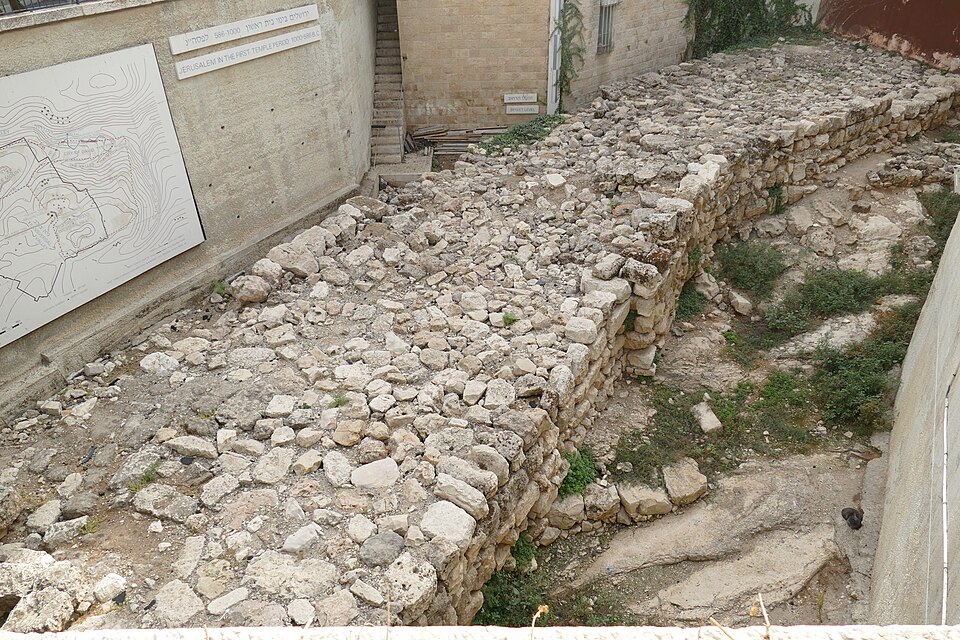
Jerusalem itself requires a different scale of analysis. Its importance in restoration literature does not establish its contemporary urban size. In their published disagreement, Israel Finkelstein and Lipschits both reconstruct a settlement far smaller than the late monarchic city, but differ over its extent. Finkelstein estimates approximately 2–2.5 hectares; Lipschits argues for about five hectares, including the Ophel near the sanctuary. The disagreement turns on the treatment of missing evidence. Finkelstein maintains that a larger settlement requires material remains that have not been found. Lipschits argues that subsequent construction, often founded directly on bedrock, removed earlier occupation and distorted its surviving distribution. The choice is not between archaeology and a literal reading of Ezra: both scholars use archaeological evidence, but assign different weight to preservation and absence. Their estimates also concern the Persian and early Hellenistic periods broadly, not a recoverable census of Jerusalem under Cyrus.²
These distinctions prevent the restoration from becoming an imagined recovery of the former kingdom. A religious centre could regain importance while remaining a modest settlement, dependent on a countryside whose institutions and productive life had continued without it.
From recovered vessels to organised construction
Ezra gives the undertaking an identifiable beginning through sacred property and appointed leadership. Sheshbazzar receives the vessels taken from the former temple; the retrospective account in Ezra 5 identifies him as Cyrus’s governor and credits him with laying the foundations. Ezra 3, however, places Zerubbabel and the priest Jeshua at the head of the foundation work. The sources do not explain this relationship sufficiently to establish a complete succession. Sheshbazzar may have initiated work subsequently directed by Zerubbabel, but that familiar reconstruction fills a narrative gap rather than reproducing an explicit chronology. Identifying the two men as one person likewise resolves the difficulty only by introducing a further hypothesis.
A firmer point of reference appears in Haggai. Its dated speeches identify Zerubbabel as governor and Joshua, Jeshua in Ezra as high priest under Darius. Whatever their earlier responsibilities, their association with an organised building campaign is more securely located in 520 BCE than in the first years of Cyrus.³ Ezra’s account nevertheless preserves a useful distinction between renewed worship and a completed sanctuary. In chapter 3, sacrifice resumes at an altar before the temple foundations are laid. The observance of festivals and regular offerings gives communal life a religious rhythm while the building remains unfinished. The text thus presents restoration first through practice, then through construction.
That sequence is plausible, but plausibility is not independent verification. The narrative also establishes the legitimacy of its leaders by connecting their actions to inherited ritual requirements. Its foundation ceremony joins priests, Levites, music, and public acclamation in a carefully ordered representation of continuity. The mingling of celebration with the grief of those who remember the former sanctuary acknowledges that renewal did not erase the difference between the remembered past and the diminished present.
Haggai offers a related but distinct perspective. He addresses people living in houses while the sanctuary remains ruined and calls on them to obtain timber and begin work. His speeches describe poor harvests, inadequate food and clothing, and wages that fail to meet household needs. These descriptions are integral to his accusation that neglect of the temple has brought divine displeasure. They are not a neutral economic survey, but they show the circumstances through which the appeal seeks to persuade: a public building project competes with immediate domestic demands. Haggai’s dated framework makes this testimony the principal chronological anchor for the discussion here. It places the mobilisation of governor, priest, and community under Darius. It does not rule out earlier worship or preliminary work; it does make the assumption of an already vigorous construction programme under Cyrus difficult to sustain without further explanation.⁴
The contrast between Ezra and Haggai is therefore more informative than an attempt to merge every notice into one continuous building record. Ezra traces legitimacy back to Cyrus and presents the project as a recovery authorised from the beginning of Persian rule. Haggai concentrates on the immediate task of persuading a community to build. One explains the undertaking’s entitlement; the other exposes the effort required to make it happen.
Opposition, resources, and authority
Ezra gives external opposition a prominent role in explaining delay. Neighbouring worshippers ask to participate, but Zerubbabel, Jeshua, and the family leaders reject their offer. Cyrus’s commission becomes the basis for an exclusive claim: the sanctuary is to be built by the community that considers itself authorised to undertake it. The dispute concerns more than relations between different religions. The proposed participants claim to worship the same deity. What the narrative contests is their standing within the project and their right to share its authority. Temple building consequently becomes a means of defining the community as well as serving it.
That conclusion concerns the narrative’s construction of legitimacy. It does not justify classifying all established inhabitants as opponents of returnees. Ezra identifies the outsiders as adversaries before recounting their actions and gives no equivalent account of their position. Its categories cannot serve as a complete description of the region’s social divisions. Chronology imposes another limit. Ezra 4 moves from resistance under Cyrus to correspondence associated with later kings, before returning to the suspension of temple work until Darius. The Artaxerxes correspondence concerns Jerusalem and its walls. It cannot establish that Cyrus’s temple project was halted by that later royal order. The chapter arranges episodes of opposition thematically rather than maintaining an uninterrupted sequence.⁵
Haggai, by contrast, places responsibility within the community. The people say that the time for rebuilding has not come; the prophet demands a change of priorities. This does not prove that external pressure was imaginary. It shows that opposition alone is an inadequate explanation. Labour, materials, subsistence, and leadership all had to be coordinated before permission could produce a functioning sanctuary.
The regional economy helps explain why that coordination mattered. Agricultural production continued, but its existence did not make every resource freely available to Jerusalem. Households had their own needs, and Ramat Raḥel’s collection system points to an administrative structure concerned with the movement of agricultural products. The evidence does not quantify the demands placed on individual families in 520 BCE, but it makes clear that temple construction occurred within an organised provincial economy, not outside one. Leadership linked the undertaking to that provincial order. Haggai addresses the governor and high priest together, presenting political and religious authority as jointly responsible for action. At the same time, his final oracle promises Zerubbabel divine election and depicts the overthrow of kingdoms. The text thus accommodates both the immediate reality of government under Darius and expectations extending beyond it. Restoration could operate within imperial structures while generating hopes that those structures did not satisfy.⁶
The resulting history is neither one of uninterrupted progress nor one of complete inactivity followed by a sudden beginning. Different forms of recovery could advance at different speeds. Sacred objects might be restored before a sanctuary stood ready to receive them; worship could resume before substantial construction; leadership could claim royal authority before it possessed the resources or consensus needed to build. This is the principal consequence of separating the processes usually gathered under “the return.” Migration did not automatically restore Jerusalem’s urban life. Religious renewal did not re-establish independent monarchy. A building authorisation did not determine the scale or timetable of implementation. Between Cyrus and Darius, restoration emerged through the interaction of inherited communities, new claims to leadership, continuing agricultural life, and the difficult mobilisation of a public project.
Cyrus’s place in this history was foundational but not sufficient. Biblical tradition associated him with the opening of restoration; the evidence for its effective organisation becomes clearer under Darius. The distance between those moments explains both the protracted character of the undertaking and the later importance of remembering a royal beginning. The final article will examine how Cyrus became a figure of deliverance in Jewish historical memory.
Bibliography
Oded Lipschits, “The Rural Economy of Judah during the Persian Period and the Settlement History of the District System,” in Marvin Lloyd Miller, Ehud Ben Zvi, and Gary N. Knoppers, eds.,The Economy of Ancient Judah in Its Historical Context(Winona Lake, IN: Eisenbrauns, 2015), pp. 237–264, especially pp. 237–240. The accessible author-uploaded text includes the published chapter, not merely its platform-generated abstract. Its account of continuity and agricultural administration supports the regional reconstruction; it does not establish individual property arrangements.
Israel Finkelstein, “Persian Period Jerusalem and Yehud: A Rejoinder,”Journal of Hebrew Scriptures9, article 24 (2009), pp. 2, 10–11; Oded Lipschits, “Persian Period Finds from Jerusalem: Facts and Interpretations,”Journal of Hebrew Scriptures9, article 20 (2009), especially pp. 4–9. Finkelstein explicitly treats his disagreement with Lipschits as a dispute about negative evidence rather than an uncritical acceptance of biblical testimony. The estimates belong to their published debate and are not presented here as a comprehensive assessment of subsequent excavation.
Ezra 1:7–11; 3:2, 8–10; 5:13–16; Haggai 1:1. These passages identify the different figures and their attributed responsibilities but do not supply a complete account of their succession.
Ezra 3:1–13; Haggai 1:1–15 and 2:3, 15–19. The article adopts Haggai’s dated setting as its working chronology rather than claiming that the dates are beyond debate. Diana Edelman proposes a substantially later reconstruction in her authorial summary, “Redating the Building of the ‘Second’ Temple.” That alternative is noted rather than adjudicated here because its full argument and the relevant scholarly responses have not been independently assessed.
Ezra 4:1–7, 12–24. The rejected offer concerns temple participation; the Artaxerxes correspondence concerns the city and its walls. Their distinction is essential to avoiding an anachronistic explanation of events under Cyrus.
Haggai 1:1, 12–15; 2:20–23; Lipschits, “Rural Economy,” pp. 238–240. The economic discussion distinguishes evidence for agricultural administration from an unattested calculation of household burdens. The interpretation of Zerubbabel’s position follows the juxtaposition of his gubernatorial title and the final oracle within Haggai.
Editorial note
The relevant arguments in the accessible publications by Finkelstein and Lipschits were consulted directly. Edelman’s alternative chronology was accessed through her own summary, not her complete monograph. Biblical texts were examined in published English translation. This article offers a focused historical synthesis, not a comprehensive review of subsequent archaeology or an independent textual-critical examination. Evidence dated broadly to the Persian period has not been treated as securely attributable to Cyrus’s reign.
Continue this collection
Between Babylon and Jerusalem — Article 3 of 4