 Iran Chronicle
Before Cities: How Village Life Took Root in the Zagros
Mehr News Agency
The emergence of village life in the Zagros was not a single transition from wandering to settlement, nor did it depend everywhere on the simultaneous adoption of crops and livestock. Early Neolithic communities established enduring places of residence while continuing to hunt animals and exploit wild plants.
Excavations at Chogha Golan, East Chia Sabz, and Sheikh-e Abad, all in present-day western Iran, reveal different combinations of building, food procurement, and attachment to place. Their significance lies not in representing successive steps towards civilisation, but in showing how varied settled life could be before cities existed. The goat management discussed in the preceding article formed one part of this broader transformation. At Ganj Dareh, selective slaughter and ancient DNA illuminate a changing relationship with animals. Elsewhere, buildings, prepared floors, grinding equipment, and accumulated deposits provide evidence for changes in the organisation of human activity. These developments overlapped, but they should not be collapsed into a single event called the beginning of farming.
A central archaeological difficulty is distinguishing repeated visits from continuous residence. Substantial walls demonstrate investment, while rebuilding shows that a location retained its importance. Neither establishes, by itself, that people stayed throughout the year.Sedentism, understood as residence in a place for most or all of the annual cycle, requires evidence beyond the mere presence of buildings. The duration of occupation, seasonal availability of resources, and formation of deposits must be considered together. A settlement mound preserves a history of activity, not necessarily an uninterrupted sequence of inhabitants.
Chogha Golan
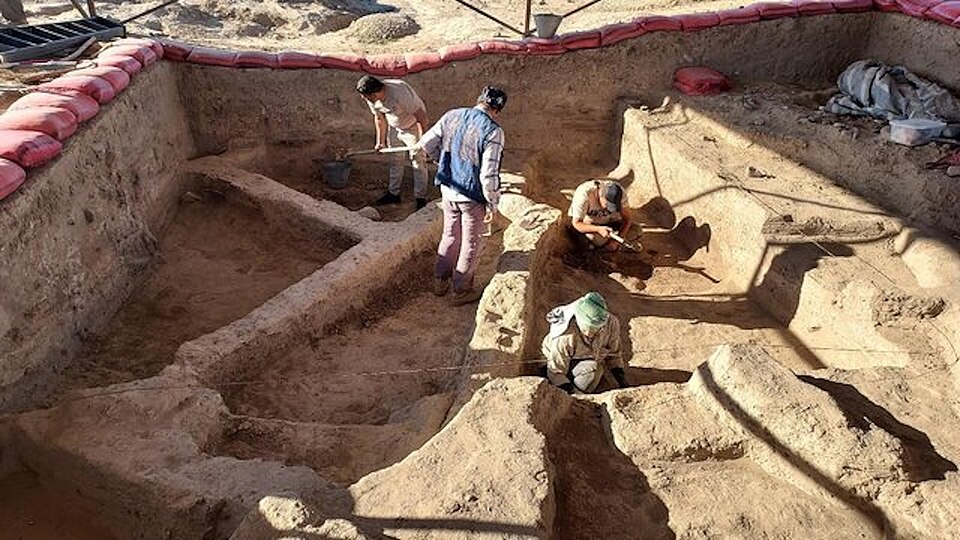
In the foothills of the central Zagros in Ilam Province, offers an unusually long perspective. Its excavators identified eleven archaeological horizons within approximately eight metres of deposits, with the occupation conventionally placed around 9750–7650 BCE. Mud-brick walls, plastered floors, building debris, and refuse deposits record successive uses of the site. Substantial architecture appears during the earlier part of the sequence, well before domesticated emmer wheat became prominent towards its end (Riehl et al., 2015; Weide et al., 2018).1
 |  |  |
Some mortars and grinding slabs were embedded in floors, making them fixtures rather than possessions routinely carried between camps. Such arrangements located work within built space and provide tangible evidence of investment in a particular setting. Yet not every stone implement was used exclusively for food: traces of pigments and asphalt show that some served other activities. Reconstructing daily routines therefore depends on examining use and context, rather than assigning an object a function from its shape alone.
The plant remains are equally important because they complicate a familiar explanation of village origins. Chogha Golan’s inhabitants exploited wild grasses, cereals, pulses, and other plants over many generations. Riehl and colleagues interpreted parts of the sequence as evidence for cultivating wild plants. A later analysis by Weide and colleagues questioned whether cultivation adequately explained the broader assemblage, emphasising instead the sustained gathering of diverse wild grasses. Domesticated emmer eventually became important, but whether earlier wild cereals were cultivated remains uncertain. The settlement demonstrates that a long-established community need not have depended from its beginning on domesticated crops (Riehl et al., 2015; Weide et al., 2018).
East Chia Sabz,
Located in the Seimareh Valley, provides a complementary architectural record. Excavations distinguished seven architectural strata in the principal sequence, including stone-built structures and paved surfaces. Radiocarbon determinations directly dated part of the occupation to approximately 8556–7611 BCE; a wider range proposed for the settlement involved extrapolation into undated deposits and should not be treated as equally secure. Mortars, querns, pestles, stone vessels, and manufacturing debris indicate recurring food-processing and craft activities (Darabi et al., 2011).2
Repeated construction at East Chia Sabz suggests that the settlement mattered beyond a single episode of occupation. Building and maintaining walls and surfaces required labour, while heavy equipment made the location useful for future work. Nevertheless, the exposed structures are sometimes small or incomplete. Their remains do not justify reconstructing an entire village plan or identifying every enclosure as a house, workshop, or granary. Food storage is a reasonable subject of investigation, but a compartment is not automatically a storeroom, and storage itself would not establish whether supplies belonged to individuals, households, or a wider community.
Sheikh-e Abad
Situated on a plain northeast of Kermanshah, it contains a deep sequence extending from early deposits around the end of the tenth millennium BCE to substantial buildings in the eighth millennium. The research project’s account describes enduring settlement alongside hunting and the exploitation of wild plants, without demonstrated cereal agriculture in the material studied. The regional botanical review likewise places its plant evidence within the broader importance of wild resources in the early Zagros Neolithic (Matthews, Matthews, and Mohammadifar, eds., 2013; Weide et al., 2018).
Its later buildings also reveal uses of space beyond subsistence. One room contained an arrangement of wild goat skulls and a wild sheep skull, with red ochre associated with part of the deposit. Researchers interpreted this as evidence for ritual activity. That interpretation recognises deliberate treatment of animal remains without recovering a complete belief system. The arrangement indicates significance beyond ordinary disposal; it does not identify a named deity or establish that all inhabitants shared identical practices.
Together, these settlements show how village life could bring activities into recurring spatial relationships: places for processing materials, depositing refuse, maintaining buildings, and treating the dead or selected animal remains. Such arrangements created conditions for repeated encounters and continuing responsibilities. Their precise social consequences remain harder to recover. Walls do not identify family structure, and investment in a location does not prove private property or political hierarchy.
The beginnings of village life in the Zagros are therefore best understood as a set of related but uneven developments. Chogha Golan demonstrates prolonged reliance on wild resources alongside substantial settlement; East Chia Sabz records repeated architectural investment and practical work; Sheikh-e Abad reveals an enduring upland community whose activities included distinctive treatment of animal remains. Farming mattered, but it was neither a universal starting point nor a sufficient explanation. Before cities, people were already creating places shaped by accumulated labour, repeated use, and relationships that extended beyond a single visit.
Footnotes
https://pmc.ncbi.nlm.nih.gov/articles/PMC4544718/
Return to referencehttps://journals.uni-lj.si/DocumentaPraehistorica/article/download/38.20/1652/3239
Return to reference
Sources & Further Reading
- Darabi, Hojjat, Reza Naseri, Ruth Young, and Hassan Fazeli Nashli · The Absolute Chronology of East Chia Sabz: A Pre-Pottery Neolithic Site in Western Iran Documenta Praehistorica 38: 255–265. DOI: 10.4312/dp.38.20.
- Matthews, Roger, Wendy Matthews, and Yaghoub Mohammadifar · The Earliest Neolithic of Iran: 2008 Excavations at Sheikh-e Abad and Jani Central Zagros Archaeological Project Reports, Volume 1. Oxford: Oxbow Books.
- Riehl, Simone, Eleni Asouti, D. Karakaya, Britt M. Starkovich, Mohsen Zeidi, and Nicholas J. Conard · Resilience at the Transition to Agriculture: The Long-Term Landscape and Resource Development at the Aceramic Neolithic Tell Site of Chogha Golan (Iran) BioMed Research International 2015: 532481. DOI: 10.1155/2015/532481.
- Weide, Alexander, Simone Riehl, Mohsen Zeidi, and Nicholas J. Conard · A Systematic Review of Wild Grass Exploitation in Relation to Emerging Cereal Cultivation throughout the Epipalaeolithic and Aceramic Neolithic of the Fertile Crescent PLOS ONE 13(1): e0189811. DOI: 10.1371/journal.pone.0189811.