 Iran Chronicle
Anshan and the House of Cyrus
A. Davey
Before Cyrus conquered Babylon, his family ruled a kingdom in southwestern Iran called Anshan. Its name belonged to an older Elamite world, raising a question at the beginning of Persian imperial history: how did a Persian royal house become established there? Part 2 of our Achaemenid Persia series examines the evidence for Cyrus’s predecessors, their relationship with Anshan, and the disputed genealogies that connect his family with Darius.
ACHAEMENID PERSIA · PART 2

After the conquest of Babylon in 539 BCE, an inscription composed in Cyrus’s name introduced his royal ancestors. He was the son of Cambyses, grandson of an earlier Cyrus, and descendant of Teispes. Each predecessor received the same designation: “great king, king of Anshan.” The conqueror of Babylon presented himself as the heir to an established royal line.1The passage survives on the Cyrus Cylinder, an Akkadian inscription that explains his victory through the favour of Babylon’s god Marduk. Its language addresses the political and religious expectations of the conquered kingdom. Within that Babylonian presentation, however, Cyrus’s ancestry leads back to South-Western Iran.
Anshan was both an ancient city and a regional name. Its city has been identified with Tall-e Malyan in Fars, within the highland territory historically associated with Elam. The title therefore raises a question that cannot be answered simply by calling Cyrus a Persian king.
what did Anshan mean to his family, and how had their authority developed there?
Finding Anshan
The identification of Anshan with Malyan changed the geographical foundations of early Persian history. Inscribed bricks recovered from the site, studied alongside related material, established the connection in the early 1970s. Anshan was not a distant kingdom that could readily be separated from Persian Fars. Its ancient city lay within the region that became the Persian imperial heartland. Excavations and surveys revealed a settlement with a much longer history than the dynasty of Cyrus. During the third and second millennia BCE, Malyan experienced periods of substantial urban development. Its buildings, administrative documents, seals, and craft production place it within the changing networks of the Iranian plateau and Elam. Middle Elamite administrative texts record transactions involving metals and other commodities.

The history was uneven. Expansion alternated with contraction, and the settlement’s earlier importance cannot be projected unchanged into the sixth century BCE. Archaeologist Kamyar Abdi’s assessment describes limited evidence for occupation after the Middle Elamite period and sparse Achaemenid remains. Cyrus’s title may therefore refer principally to the surrounding region rather than demonstrate that his court occupied the old city.2This is an important limit. We can locate ancient Anshan without claiming to have discovered the residence of Cyrus’s grandfather, nor does the decline of Malyan prove that every political community in its hinterland disappeared. The settlement and the territory require separate consideration.
The Elamite setting
Anshan had a place in royal geography long before Cyrus. Earlier rulers used titles such as “king of Anshan and Susa,” connecting the highland region with the lowland centre in what is now Khuzestan. Their relationship changed over time; Elam should not be imagined as a state whose boundaries and institutions remained constant for centuries. By the early seventh century BCE, Assyrian records depict a complicated landscape of rulers and alliances. In an account of the battle of Halule in 691 BCE, Sennacherib listed Anshan among the forces assembled with the Elamite king against Assyria. What this reveals about Anshan’s precise political status remains open to interpretation.
 |  |
|---|
D. T. Potts argues that the passage provides evidence for a recognisable highland polity, distinct from the lowland kingdom centred on Susa. He places Cyrus’s ancestors within that Anshanite setting and challenges the assumption that their kingdom should automatically be described as Persian. Other reconstructions give greater weight to the emergence of Persian authority within an Elamite environment. Matt Waters, for example, interprets the Anshanite title as an important expression of the Elamite traditions through which a Persian dynasty legitimised its rule. The difference is substantive.
Were Cyrus’s ancestors best understood as rulers of a continuing Anshanite polity, or as Persian rulers drawing on the authority of an older regional kingdom?
The surviving title establishes an association with Anshan. It does not, by itself, decide between those explanations. What should remain central is the historical setting. The family did not emerge in a region without political traditions, administrative experience, or established communities. Whatever reconstruction we adopt, its rise belongs within the history of southwestern Iran, rather than outside it.
What Cyrus’s genealogy establishes

The Cylinder identifies three predecessors:
Cambyses
Cyrus,
Teispes.
Modern numbering distinguishes Cyrus the Great as Cyrus II, his grandfather as Cyrus I, and his father as Cambyses I. These numbers are historical conveniences, not ancient royal titles. The genealogy is valuable evidence, but its purpose matters. Cyrus had conquered Babylon and was being presented as a legitimate ruler favoured by its gods. Describing his ancestors as great kings supported that presentation. The inscription gives direct evidence for the ancestry he publicly claimed; it does not independently document the reign, territory, and achievements of every predecessor.
There is a further reason to examine its formulation carefully. Antigoni Zournatzi argues that the Cylinder’s designation “king of the city of Anshan” accommodated Mesopotamian and Elamite expectations of legitimate kingship. On this reading, the title’s role in the Babylonian account is more important than attempts to extract an ethnic identity from it. David Stronach likewise explored alternatives to reading the Cylinder as a straightforward description of an exclusively Anshanite dynasty. This does not make Anshan a Babylonian invention. Cyrus also appears as king of Anshan in other Babylonian evidence, including texts associated with Nabonidus. It does mean that the repeated titles on the Cylinder cannot be detached from the setting in which the genealogy was composed.
Anshan could be a territorial designation, an inherited claim to authority, and a useful element in royal presentation. Those possibilities need not exclude one another.
A seal bearing the name Cyrus

A second connection between Cyrus’s family and Anshan survives in an unusual form. Impressions of a seal, catalogued as PFS 93*, occur on administrative tablets from the Persepolis Fortification archive. Its Elamite inscription is conventionally rendered
Cyrus the Anshanite, son of Teispes.
The combination of names makes an association with Cyrus the Great’s grandfather attractive. The seal is often treated as an older object retained in use under Darius, whose reign supplies the dates of the surviving administrative documents. Its interpretation nevertheless requires care. The impressions are later than the person to whom the seal is commonly attributed, while the original object has not survived. Scholars have debated its style, date, and historical identification. Mark Garrison’s specialist study examines its place within the artistic and political world of southwestern Iran rather than treating the inscription as a self-sufficient solution to the early dynasty.
The wording also has a specific limit: it identifies an Anshanite affiliation and a father named Teispes, but does not call its owner king.3The seal and the Cylinder thus provide a meaningful convergence without being identical kinds of evidence. Together they strengthen the connection between Anshan and the names in Cyrus’s genealogy. They do not reveal how Teispes acquired authority or establish the exact borders of his descendants’ kingdom.
Cyrus of Parsumash
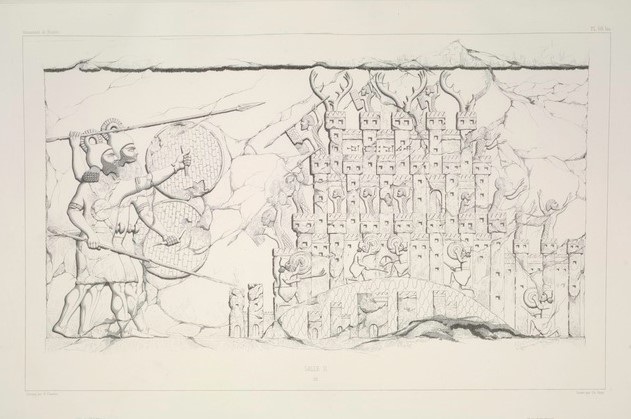
An Assyrian account supplies another possible connection. Ashurbanipal recorded that Cyrus, king of Parsumash, sent his eldest son Arukku with tribute to Nineveh after hearing of the Assyrian king’s victory over Elam. The episode has often been associated with Cyrus I. If the identification is correct, it places Cyrus the Great’s grandfather within the diplomatic pressures created by Assyria’s campaigns in the seventh century BCE. Sending a royal son would have provided Assyria with a personal guarantee of the relationship, as well as a visible acknowledgement of its power.
But the account names a king of Parsumash, not a son of Teispes or a king of Anshan. The identification depends on connecting those pieces of information. Waters has accepted or worked with that connection in his reconstruction. Potts rejects it, arguing that Parsumash and Anshan should be distinguished and that the recurrence of the name Cyrus is insufficient to make their rulers the same person. We therefore cannot write Arukku securely into Cyrus the Great’s family tree. Nor should the Assyrian reference become a firm date for the establishment of his ancestors’ kingdom.
 |  |  |
|---|
The distinction also carries forward a problem raised in in previous article. Parsua, Parsumash, and Persian Pārsa cannot simply be arranged as successive stages of one migration. Similar names require linguistic and geographical investigation; they do not themselves document the movement of a single identifiable community to Fars. Assyrian warfare belongs to the background of the dynasty’s emergence. Its exact consequences for Anshan are harder to reconstruct. The sack of Susa was a major political event, but it does not supply an automatic founding date for a new kingdom farther east.
Was Cyrus an Achaemenid?

Cyrus’s genealogy on the Cylinder ends with Teispes. It does not name Achaemenes. Darius’s Behistun inscription presents a different ancestry. Darius traces his descent through Hystaspes, Arsames, Ariaramnes, and Teispes to Achaemenes, explaining that this is why his family is called Achaemenid. He also claims that his family had possessed kingship before him.⁷
The traditional reconstruction joins the two genealogies through Teispes. One branch leads to Cyrus; another leads through Ariaramnes to Darius. That reconstruction remains possible, but it involves more than reproducing a single ancient family record. It combines statements made by different kings under different circumstances. The disparity has encouraged scholars to distinguish Cyrus’s Teispid line from Darius’s Achaemenid line. In an influential study, Waters argued that Darius incorporated Cyrus’s royal house into an Achaemenid dynastic framework. He nevertheless proposed a connection through marriage: Herodotus identifies Cyrus’s wife Cassandane, the mother of Cambyses, as the daughter of an Achaemenid named Pharnaspes.
Waters’s interpretation is not simply that two wholly unconnected families succeeded one another. It allows a marriage relationship while questioning the shared paternal descent implied by the conventional family tree. That reconstruction is itself debated. Reza Zarghamee has challenged the tendency to treat a Teispid–Achaemenid divide as established fact. He argues that the absence of Achaemenes from the Cylinder does not prove Cyrus lacked an Achaemenid affiliation, and that Darius’s political reasons for asserting kinship do not establish that the kinship was invented.4
This is a necessary distinction. A claim can be politically advantageous and historically true. Conversely, an ancient king’s confident assertion does not remove the need for scrutiny. The evidence supports a clear difference in surviving royal presentation: Cyrus emphasised his Anshanite ancestors, while Darius repeatedly identified himself as an Achaemenid. Whether that difference demonstrates separate paternal dynasties remains unresolved.
The inscriptions at Pasargadae
Pasargadae appears to offer a direct answer. Inscriptions there identify Cyrus as an Achaemenid. The familiar short text declares:
“I am Cyrus, the king, an Achaemenid.”
The difficulty is determining when these inscriptions were commissioned. A prominent interpretation attributes them to Darius, connecting their use of Old Persian writing and their dynastic language with his reign. If so, they would show how Darius represented Cyrus, rather than independently preserve Cyrus’s own claim. Waters adopts that attribution. More recent criticism, including Zarghamee’s, disputes how decisively the evidence establishes Darius’s sole responsibility for the texts.
The safest conclusion is narrower than either extreme. The Pasargadae inscriptions attest an Achaemenid designation for Cyrus, but their disputed commissioning limits their ability to settle his relationship with Darius. Even if Darius supplied the designation, that would not alone prove it false. If some inscriptions belonged to Cyrus’s lifetime, the argument for his own use of the name would become substantially stronger.
The uncertainty should remain visible rather than being resolved through a confident label on a family tree.
A kingdom within a changing landscape
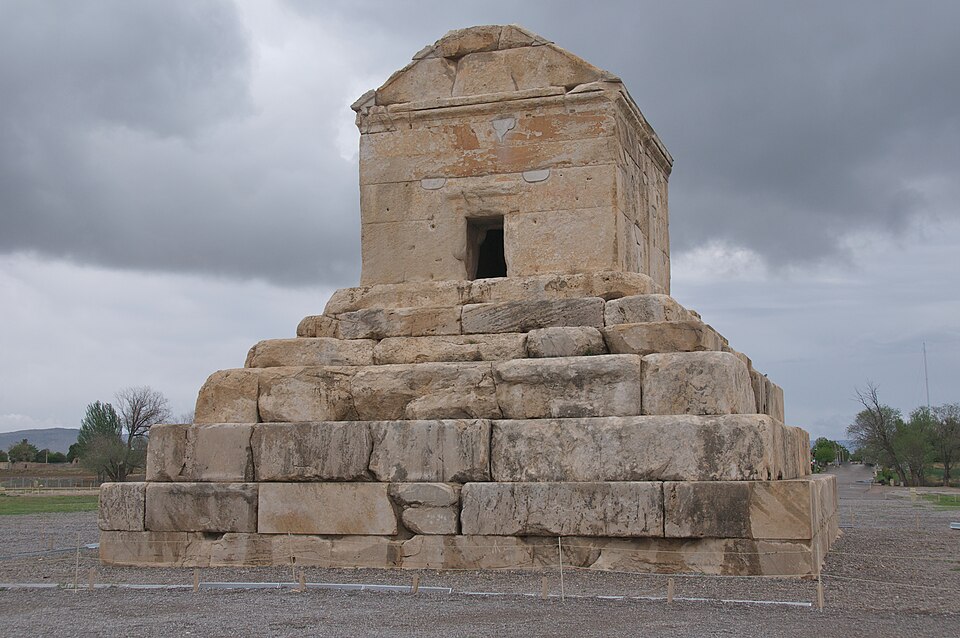
Cyrus’s early background cannot yet be reconstructed as a continuous sequence of reigns and conquests. Teispes, Cyrus I, and Cambyses I remain much less securely documented than the empire their descendant created. Several conclusions nevertheless hold. Anshan belonged to the historical geography of Elam and lay within Fars. Cyrus publicly associated his family with its kingship. The surviving seal inscription offers a further connection between Anshan and the names Cyrus and Teispes, although its precise attribution requires qualification. Darius subsequently presented imperial ancestry through Achaemenes, creating the framework within which much later dynastic history has been understood.
 |  |
|---|
The disagreements concern how those observations fit together. They do not justify removing the Elamite setting from Persian history, or replacing a simple Persian origin story with an equally exclusive Anshanite one. Royal titles, geographical affiliations, language, and ancestry illuminate different aspects of a political world whose boundaries were changing.
In previous Article, we argued that the emergence of Iranian-speaking societies involved both movement and enduring local communities. Anshan makes the political implications of that argument more concrete. The early monarchy developed within a landscape shaped by older kingdoms, regional elites, and connections with Mesopotamia. Its history cannot be recovered solely from the later empire’s account of itself.
Cyrus inherited or claimed a place within that world before his victories transformed its scale.
The next article turns to his confrontation with Astyages, the evidence for the overthrow of Median power, and the expansion that carried the king of Anshan beyond southwestern Iran.
Footnotes
https://cdli.earth/artifacts/386349
Return to referencehttps://www.iranicaonline.org/articles/malian/
Return to referencehttps://www.ancienthistorybulletin.org/subscribed-users-area/wp-content/uploads/2025/12/Zarghamee-1.pdf
Return to referencehttps://www.ancienthistorybulletin.org/subscribed-users-area/wp-content/uploads/2025/12/Zarghamee-1.pdf
Return to reference
Sources & Further Reading
- Cyrus Cylinder especially lines 12 and 20–22 Source
- Kamyar Abd · Maliān Encyclopaedia Iranica, published 2005, updated 2012 Source
- D. T. Potts · Cyrus the Great and the Kingdom of Anshan
- Vesta Sarkhosh Curtis and Sarah Stewart · Birth of the Persian Empire (2005) pp. 7–28
- Matt Waters · Cyrus and the Achaemenids,
- Iran 42 (2004) Journal pp. 93–95
- Antigoni Zournatzi, · Cyrus the Great as a ‘King of the City of Anshan,
Continue this collection
Achaemenid Empire — Article 2 of 6